



India's Most Ambitious Lunar Mission Yet
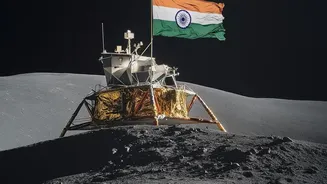
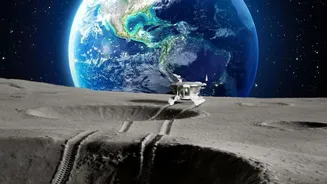
Chandrayaan-4 represents a monumental leap in complexity for India's space program. While Chandrayaan-3 celebrated a triumphant landing near the lunar south pole, its successor is tasked with a round-trip journey. The primary goal is to land on the Moon,
collect up to three kilograms of lunar soil and rock (regolith), and return it safely to Earth for study. If successful, India will join an elite club of nations—currently just the United States, Russia, and China—that have accomplished a lunar sample-return mission. This mission is not simply an incremental update; it's a new frontier, requiring technologies and manoeuvres India has never attempted before on a lunar mission, including launching a vehicle off the Moon's surface.
A Complex Dance of Five Modules and Two Launches
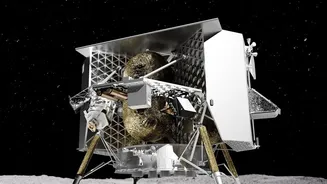
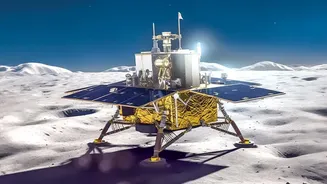
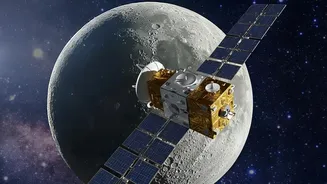
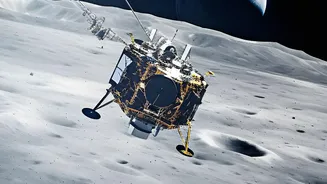
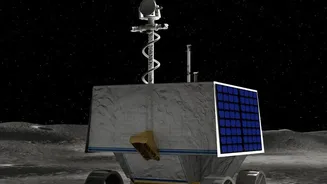
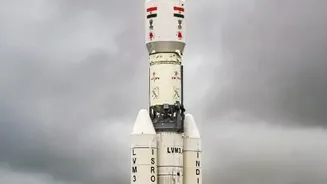
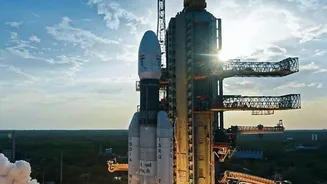
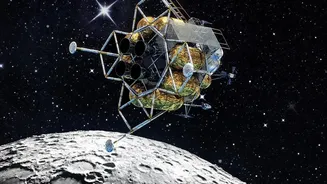
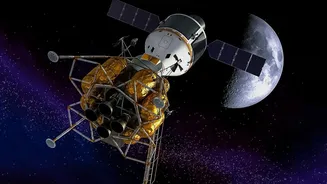
The sheer difficulty of Chandrayaan-4 is reflected in its architecture. The spacecraft is so heavy that it will be launched in two separate parts using two LVM3 rockets. The mission is composed of five distinct modules: a Propulsion Module, a Descender (lander), an Ascender, a Transfer Module, and a Re-entry Module. The plan involves the Descender landing on the Moon with the Ascender on top. A robotic arm will collect soil and drill for subsurface samples, which will then be sealed in a container inside the Ascender. The Ascender will then launch from the Moon—a first for India—to dock with the Transfer and Re-entry modules waiting in lunar orbit. After the precious cargo is transferred, the Re-entry Module will journey back and land on Earth.
Why Bring Back Moon Rocks and Ice?
Studying lunar samples on Earth provides scientific insights that are impossible to achieve with robotic instruments on the Moon alone. Laboratories on Earth are equipped with massive, delicate, and state-of-the-art equipment—like mass spectrometers and electron microscopes—that could never be launched into space. These tools can unlock secrets about the Moon's origin, its geological history, and the evolution of our solar system. Moreover, the samples from the south pole are particularly valuable. This region is believed to contain water ice in permanently shadowed craters. Analyzing this ice could confirm its quantity and composition, which is crucial for future human exploration. Lunar water could potentially be converted into drinking water, breathable oxygen, and even rocket fuel, making it a vital local resource for sustaining a future Moon base.
Overcoming Unprecedented Challenges
The technical hurdles for Chandrayaan-4 are immense. The mission requires mastering several new capabilities, most notably automated rendezvous and docking in lunar orbit, a feat ISRO has been preparing for with precursor missions like the Space Docking Experiment (SPADEX). Executing a launch from the lunar surface, transferring the sample container between modules in deep space, and ensuring the sample's pristine condition upon return are all major challenges. The entire sequence must be performed with robotic precision hundreds of thousands of kilometres from home. Each step, from the soft landing to the sample collection and atmospheric re-entry, must work flawlessly for the mission to succeed.
Timeline and the Road Ahead
The Union Cabinet approved the Chandrayaan-4 mission on September 18, 2024, with a budget of over ₹2,100 crore. While initial timelines suggested a launch by 2027, ISRO is now targeting 2028 for the launch of this highly complex mission. This mission is not just a standalone scientific endeavor; it's a critical stepping stone. The technologies developed and proven for Chandrayaan-4, especially orbital docking and sample return, are foundational for India's long-term space ambitions, including its goal to send an astronaut to the Moon by 2040 and establish a space station.