


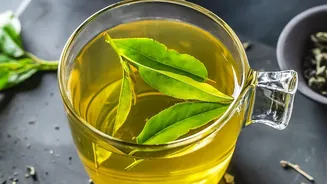
Ever wonder why your homemade green tea tastes more like a punishment than a pleasure? The culprit is likely boiling water. We'll explain the simple science behind this common mistake and show you how to brew a perfect, smooth cup every single time.
The Science of Bitterness
If
you've been disappointed by a harsh, bitter cup of green tea, you're not alone. The good news is that the tea itself isn't usually the problem—it's the preparation. Green tea leaves contain natural compounds called catechins and tannins. These polyphenols are powerful antioxidants, but they are also responsible for bitterness and astringency, which is that dry, puckering feeling in your mouth. When you pour boiling water (100°C) directly onto delicate green tea leaves, you effectively scorch them. This aggressive heat causes a rapid, excessive release of these bitter compounds, overwhelming the tea's more subtle, sweet, and vegetal flavours. The result is a one-dimensional, harsh brew that masks the true character of the tea. It's not that you are 'burning' the leaves, but rather flash-extracting all the wrong molecules at once.
Finding the Sweet Spot: The Ideal Temperature
The secret to a balanced, flavourful cup of green tea is control, and the most important variable to control is water temperature. Most green teas brew best in water that is between 70°C and 85°C (roughly 160°F to 185°F). In this cooler temperature range, you achieve a more balanced extraction. The sweet and savoury notes from compounds like L-theanine are drawn out, while the release of bitter catechins is kept in check. Some delicate, shade-grown Japanese green teas like Gyokuro prefer even cooler water, sometimes as low as 50-60°C, to highlight their rich, umami flavour. Conversely, hardier roasted green teas like Hojicha can handle hotter water. But for the everyday green tea you have in your pantry, aiming for that sub-boiling sweet spot is the single most effective change you can make.
How to Get the Temperature Right Without a Thermometer
You don't need a fancy variable-temperature kettle to dramatically improve your green tea. The simplest method is to boil your water and then let it cool. Bring your kettle to a full boil, then turn it off, open the lid, and let it stand for about three to five minutes. This will naturally bring the temperature down into the ideal range. Another easy trick is to pour the boiling water from your kettle into your serving mug first. Let it sit for a minute to warm the mug, then pour that water over your tea leaves in a separate infuser or pot. Each transfer to a new vessel helps dissipate heat, lowering the temperature. Some tea masters even watch for the size of the bubbles in the kettle; when small streams of bubbles are steadily rising but before a full, rolling boil, the water is often in the right zone for green tea.
Don't Forget Steeping Time
Temperature is only half of the equation; time is the other critical factor. Even with perfect-temperature water, over-steeping green tea will result in a bitter cup. The longer the leaves sit in water, the more tannins are extracted. For most loose-leaf green teas, a steeping time of one to three minutes is standard. Many Japanese green teas, like Sencha, are best after just 60 to 90 seconds, while some Chinese varieties may need two to three minutes. It's always best to start with a shorter time, taste the tea, and then decide if it needs longer. Remember to remove the leaves completely from the water once the time is up to stop the extraction process. Many high-quality green teas are designed to be steeped multiple times, with each infusion revealing a new layer of flavour.