


The Sun's Unseen Threat
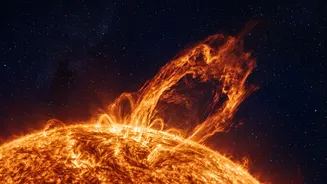
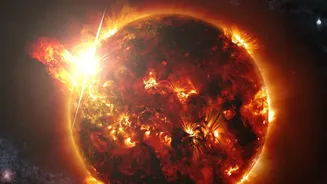
Solar storms, or geomagnetic storms, are major disturbances in Earth's magnetic field caused by solar events like coronal mass ejections (CMEs). These events eject vast clouds of plasma and magnetic fields from the Sun's atmosphere. If Earth is in the path
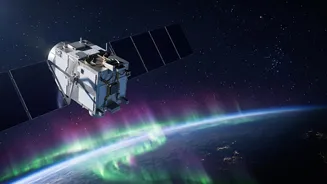
of a CME, the consequences can be severe. These storms can induce powerful electrical currents in power grids, potentially causing widespread blackouts by damaging critical transformers. They also pose a significant risk to the thousands of satellites orbiting our planet, which are essential for everything from GPS navigation and communication to financial transactions. The charged particles can damage sensitive electronics and increase atmospheric drag, causing satellites to fall out of orbit. In a world deeply reliant on this infrastructure, a major solar storm is not just an astronomical curiosity; it's a significant economic and societal threat.
The Old Way of Watching the Skies
For decades, forecasting space weather has been a complex and often slow process. Scientists have relied on a network of space- and ground-based observatories to watch the Sun for signs of an impending eruption. Traditional models are primarily based on the physics of how solar particles travel through space. While these methods are scientifically sound, they have limitations. They can be slow to run, and they often provide forecasts that are either very broad or specific to only a small geographic area. The challenge has been to create a warning system that is both fast enough to be useful and precise enough to pinpoint where on Earth the impact will be felt most strongly. Providing a few hours, or even days, of warning is helpful, but for grid operators and satellite controllers, every minute counts.
AI Enters the Picture
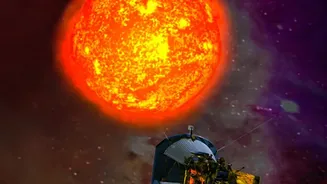
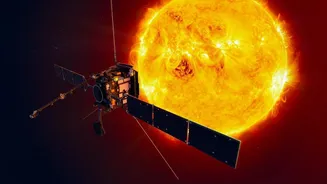
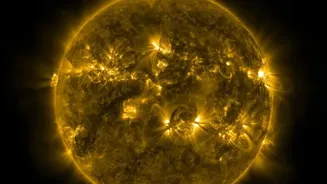
This is where artificial intelligence is creating a paradigm shift. Researchers are now training sophisticated AI models on immense archives of solar data collected by satellites like NASA's Solar Dynamics Observatory (SDO). One such pioneering model is called DAGGER (Deep Learning Geomagnetic Perturbation). By combining AI with real-time data from spacecraft measuring the solar wind, DAGGER can predict the location and severity of a solar storm's impact anywhere on Earth with just 30 minutes of advance warning. Led by researchers including Vishal Upendran from India's Inter-University Centre for Astronomy and Astrophysics, the model represents a breakthrough in providing rapid and actionable alerts. It sifts through complex data far faster than a human could, identifying subtle patterns that precede a geomagnetic disturbance.
Faster, Smarter Warnings
The key advantage of AI models like DAGGER and another called Surya, developed by NASA and IBM, is their speed and precision. The DAGGER model can produce a global prediction in less than a second and updates its forecast every minute. This 30-minute window is a critical buffer. It could provide power grid operators enough time to reroute power or take vulnerable systems offline, preventing a cascade of failures. Satellite operators could orient their spacecraft to better protect sensitive components or prepare for trajectory adjustments. Previous models either gave localised forecasts or global ones that weren't timely. AI bridges that gap, offering the first system to provide predictions that are both globally comprehensive and delivered quickly enough to enable preventative action, a crucial step in mitigating the worst effects of space weather.
Why This Matters for India
For a nation rapidly expanding its digital infrastructure and space-based assets, improved solar storm forecasting is of paramount importance. India's reliance on technology, from its robust mobile payment networks to its critical infrastructure, makes it vulnerable to the disruptions caused by geomagnetic storms. Furthermore, India operates its own constellation of navigation satellites, NavIC, which, like all satellite systems, is susceptible to space weather. Accurate, localised warnings can help protect these vital national assets, ensuring the stability of communication networks and the power grid that underpins the economy. The involvement of Indian researchers in developing these cutting-edge AI models underscores the country's growing role in global space science and its commitment to safeguarding its technological future.