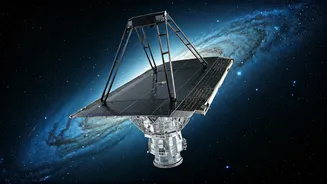




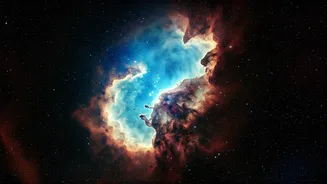


A Panoramic View Like Never Before
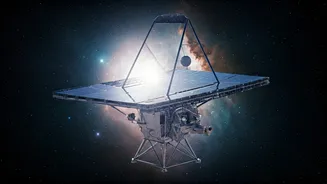
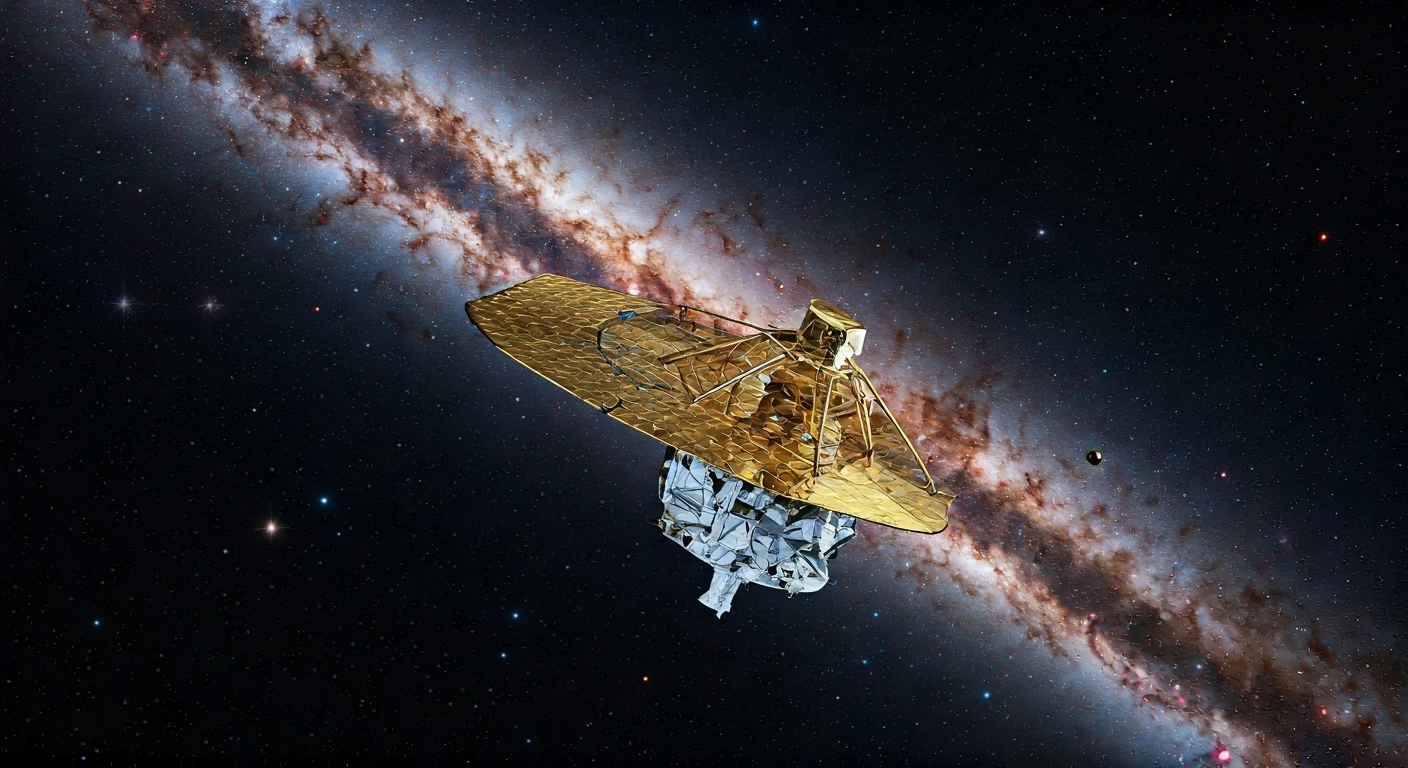
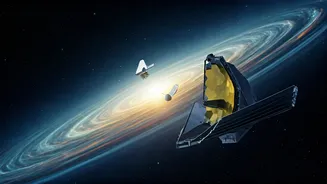
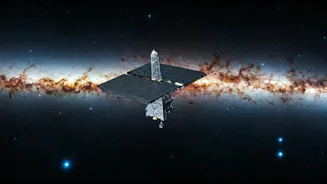
Before diving into the big questions, it's essential to understand what makes Roman a game-changer. While its primary mirror is the same size as the Hubble Space Telescope's at 2.4 meters, its power lies in its perspective. The Roman Telescope's Wide
Field Instrument gives it a field of view at least 100 times larger than Hubble's infrared camera. Imagine trying to photograph a massive mural. While Hubble would capture a detailed close-up of a single brushstroke, Roman can photograph the entire mural in similar detail. This ability to create vast, high-resolution maps of the universe is what will enable it to gather unprecedented amounts of data, measuring the light from over a billion galaxies during its mission.
Question 1: What is Dark Energy?
One of the most profound mysteries in physics is dark energy. In the late 1990s, astronomers discovered that the expansion of the universe is not slowing down but accelerating. Dark energy is the name given to the mysterious force driving this acceleration, and it's believed to make up about 68% of the universe. Roman will investigate dark energy using three different methods. It will conduct a massive survey of galaxies to map their distribution, looking for patterns called Baryon Acoustic Oscillations. It will also hunt for thousands of Type Ia supernovae—exploding stars with a known intrinsic brightness—to measure their distances and how fast they are moving away from us. Finally, it will study how the images of distant galaxies are distorted by the gravity of matter in between, a technique called weak gravitational lensing. Together, these methods will provide a 3D map of the cosmos and help determine if dark energy's influence has changed over time.
Question 2: Where is the Dark Matter?
Dark matter is another enigmatic component of our universe. It doesn't emit or reflect light, but its gravitational pull is what holds galaxies and galaxy clusters together. We know it's there because we can see its effects on the things we *can* see. Roman will create the largest-ever map of the universe's dark matter distribution. By surveying hundreds of millions of galaxies, the telescope will analyze how their light is bent and distorted by the gravity of unseen dark matter clumps. This weak gravitational lensing technique will allow scientists to 'see' the invisible scaffolding of the cosmos, providing crucial insights into the nature and distribution of this mysterious substance.
Question 3: Are We Alone?
While Roman won't directly search for life, it will complete a crucial census of planets beyond our solar system, or exoplanets, bringing us a step closer to understanding our place in the cosmos. The mission will primarily use a technique called gravitational microlensing. This occurs when a star and its planets pass in front of a more distant star, and their combined gravity acts like a lens, briefly magnifying the background star's light. This method is sensitive enough to find planets with masses as low as Mars, including 'rogue planets' that don't orbit a star. Unlike other methods that are biased toward finding large planets close to their stars, microlensing is ideal for finding worlds farther out, similar to the planets in our own solar system. Roman is expected to discover thousands of exoplanets, providing a statistical treasure trove that will help scientists understand how planetary systems form and evolve.