




What Are Solar Flares?
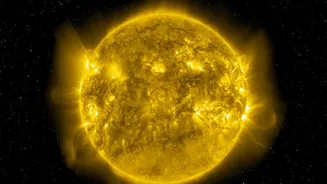
A solar flare is a massive, sudden explosion on the Sun's surface. It happens when the immense magnetic energy stored in the Sun's atmosphere gets tangled and suddenly snaps, releasing a tremendous burst of radiation. This energy travels across the entire
electromagnetic spectrum, from radio waves to powerful X-rays and gamma rays. These events are classified by their X-ray brightness, with X-class being the most powerful, followed by M, C, B, and A-class. While the light from a flare reaches Earth in just eight minutes, its effects can be far-reaching, impacting everything from radio communications to our power grids.
The Crucial First Moments
For scientists, the most important part of a solar flare is its very beginning—the 'impulsive phase'. This is the moment of initial energy release, where particles are accelerated to incredible speeds. Understanding this phase is like finding the 'genesis' of the explosion; it holds the key to predicting the flare's entire lifecycle and its potential impact. However, this initial burst is incredibly fast and difficult to capture. For decades, studying this phase has been a major challenge, as the signals are fleeting and complex. Catching this first spark is crucial for building better models to forecast space weather.
Enter HEL1OS: Aditya-L1's Flare Catcher
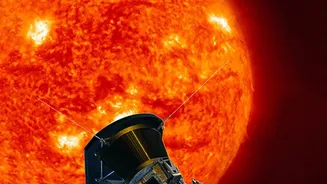
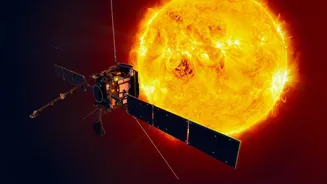
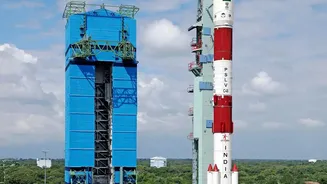
This is where India's Aditya-L1 mission comes in. Onboard the spacecraft is a crucial instrument called the High-Energy L1 Orbiting X-ray Spectrometer, or HEL1OS. Developed by ISRO, HEL1OS is designed specifically to be a 'harbinger of flaring activities'. Its primary job is to watch the Sun and wait for the tell-tale signs of a flare. Positioned at Lagrange Point 1 (L1), about 1.5 million kilometres from Earth, Aditya-L1 has a continuous, uninterrupted view of the Sun, which is something satellites in low Earth orbit don't have. This unique vantage point allows HEL1OS to monitor the Sun without blinking.
How It Sees the Unseen
So, why is HEL1OS so good at this? The secret lies in what it's designed to see: hard X-rays. The very first, impulsive phase of a solar flare releases a torrent of high-energy (or 'hard') X-rays. While other emissions follow, these X-rays are the first signature of the explosion. HEL1OS is equipped with special detectors—Cadmium Telluride (CdTe) and Cadmium Zinc Telluride (CZT)—that are precisely tuned to detect X-rays in the 10 to 150 keV energy range. This allows it to capture the flare's initial, explosive energy release with very high timing and spectral resolution. In doing so, it provides invaluable data on how and where the flare's energy is accelerating particles, something that was previously very difficult to study.
Why This Matters for India and the World
Capturing the initial burst phase of a solar flare isn't just an academic achievement; it has real-world consequences. The radiation and particles ejected by powerful flares can create geomagnetic storms that threaten our technologically dependent world. These storms can damage communication satellites, disrupt GPS signals, endanger astronauts, and even bring down power grids on Earth. By studying the very beginning of these events, HEL1OS provides crucial data that will help scientists improve their space weather prediction models. Better forecasting means we can get earlier warnings to protect our vital infrastructure, from satellites in orbit to power systems on the ground. With HEL1OS, ISRO and India are making a vital contribution to global science and the safety of our technological society.