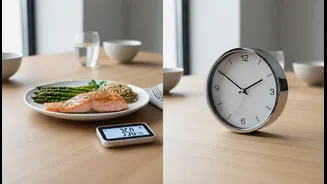









The Constant Buzz Around Fasting
Intermittent fasting, or IF, has become one of the most talked-about wellness trends. Instead of focusing on what you eat, it centres on when you eat by cycling between periods of eating and fasting. The most popular method is time-restricted eating (TRE),
often in a 16:8 format, where you fast for 16 hours and eat within an 8-hour window. Proponents claim it can lead to weight loss, improved heart health, and better memory. For many, the appeal lies in its simplicity compared to constant calorie counting. However, the scientific community has been engaged in a long-running debate: is it truly more effective than traditional dieting, and what are its long-term effects? For years, studies have offered conflicting results, leaving many people wondering what to believe.
A New Study on Long-Term Success
A new secondary analysis published in Clinical Nutrition provides a fresh perspective on this debate. Researchers looked at a group of 99 overweight or obese adults in Spain who had completed a 12-week program combining a Mediterranean diet with different eating schedules. One group followed early time-restricted eating (an 8-hour window before 10 a.m.), another followed late TRE (an 8-hour window after 1 p.m.), a third chose their own 8-hour window, and a control group had no time restrictions. The key question was what happened a full year after the initial program ended. The findings suggest that the benefits of a short period of intermittent fasting may have surprisingly long-lasting effects.
What the Research Actually Found
At the one-year mark, participants who had followed any form of time-restricted eating for just 12 weeks had maintained greater weight loss compared to the control group. This suggests that even a relatively short stint of IF might help sustain weight loss long after you stop the strict regimen. The timing of the eating window—whether early or late—did not seem to matter for overall weight maintenance, offering flexibility for fitting the diet into different lifestyles. However, the study also raised an important concern. Some participants in the TRE groups also lost more fat-free mass, which includes muscle. The late TRE group, in particular, maintained larger decreases in waist and hip measurements but also saw a reduction in this crucial lean mass. This finding adds a critical layer of nuance to the benefits of IF.
Putting It All in Context
This new research adds to a complex and evolving picture. Many previous studies have concluded that when it comes to weight loss, IF is generally no more effective than traditional calorie restriction—both methods work if they help you consume fewer calories overall. However, some research suggests IF might feel easier to stick with for some people, as it requires less constant mental effort around food choices. The most controversial recent findings came from a preliminary study presented at an American Heart Association conference, which linked an 8-hour eating window to a higher risk of cardiovascular death. However, that research has been heavily criticized for being unpublished and not yet peer-reviewed, and it contrasts with other studies showing IF can improve heart health markers like blood pressure and cholesterol. The new study on long-term maintenance offers a different angle, focusing not on initial loss but on sustainability.
What This Means for You
So, should you try intermittent fasting? This new study reinforces that there is no one-size-fits-all answer. The good news is that TRE appears to be a flexible tool that can support long-term weight management. The fact that both early and late eating windows were effective is a major plus for real-world application. However, the potential for losing muscle mass is a significant drawback that shouldn't be ignored, especially for older adults or those focused on fitness. To counteract this, combining time-restricted eating with resistance training and ensuring adequate protein intake could be crucial. Ultimately, the best diet is one that aligns with your health goals, fits your lifestyle, and that you can maintain without feeling overly restricted.