



A Sweet Discovery in a Cosmic Cloud
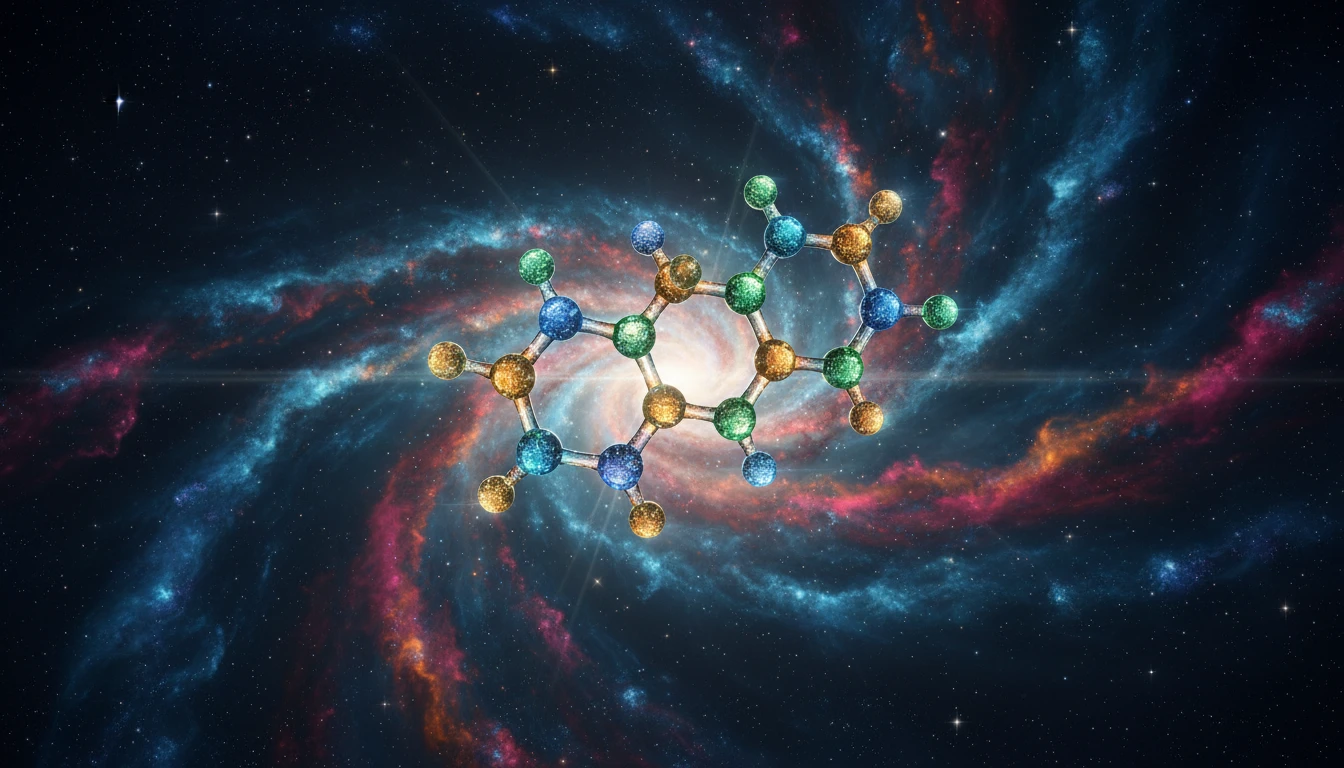
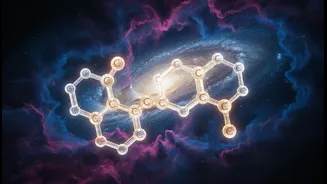
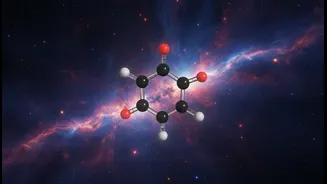
An international team of astronomers has detected the distinct chemical signature of erythrulose, a four-carbon sugar, for the first time in interstellar space. The molecule was found swirling in a vast, dense cloud of gas and dust known as G+0.693-0.027,
located approximately 27,000 light-years away near the center of the Milky Way. While we know this sugar on Earth—it’s found in raspberries and is even used in some sunless tanning products—finding it in deep space is a landmark discovery. It represents one of the most complex non-cyclic molecules ever found between the stars, suggesting that the building blocks for life are not just possible, but perhaps widespread in the galaxy.
How to Find Sugar from 27,000 Light-Years Away
Detecting a specific molecule across such immense distances is a remarkable feat of science. Researchers used powerful radio telescopes in Spain, the Yebes 40-meter and IRAM 30-meter facilities, to listen for faint radio signals emitted from the molecular cloud. Every molecule vibrates and rotates at specific frequencies, creating a unique spectral 'fingerprint'. The team painstakingly matched the signals from the cloud to the known fingerprint of erythrulose measured in a laboratory. After identifying 12 distinct spectral lines that matched the sugar, they could confidently confirm its presence. This process, called spectroscopy, allows astronomers to perform a chemical inventory of distant cosmic objects without ever leaving Earth.
A Prebiotic Pantry in the Sky
The discovery of erythrulose is so significant because it helps solve a long-standing puzzle in the origin-of-life story. Scientists have struggled to explain how simple sugars, which are essential for life, could have formed in large enough quantities on early Earth. Laboratory experiments that try to replicate prebiotic conditions on our planet tend to produce only tiny amounts of these crucial molecules. This new finding suggests an alternative source: space itself. The raw ingredients for life, including complex sugars, may have formed on icy dust grains in interstellar clouds long before planets even existed. These molecules could then be incorporated into asteroids and comets, which later delivered this precious cargo to young, forming planets like our own. This idea is supported by the previous discoveries of sugars in meteorite samples and on the asteroid Bennu.
From Stardust to the Building Blocks of Life
Erythrulose itself is not a direct component of DNA or RNA, the genetic molecules of life. However, it belongs to the same chemical family and is considered a key prebiotic molecule. Sugars are vital for living systems; they provide energy and form the structural backbone of nucleic acids like RNA. Scientists believe that erythrulose, formed in space, could have provided the raw material for reactions that led to the creation of molecules like ribose, the sugar at the heart of RNA. The presence of erythrulose therefore strengthens the theory that the universe is a vast chemical factory, capable of producing the complex ingredients necessary for biology to emerge. This makes the cosmos a far more promising place in the search for life beyond Earth.