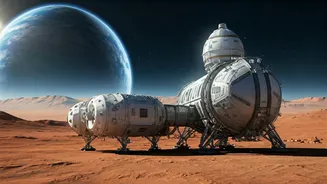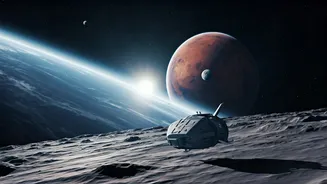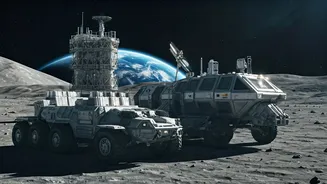










The New Lunar Benchmark
Landing on the Moon, once a feat accomplished only by superpowers, has become the new benchmark for any nation with serious space ambitions. India’s successful Chandrayaan-3 mission, which made it the first country to soft-land near the lunar south pole
in August 2023, was a monumental achievement. This, along with subsequent missions like Japan's collaboration on LUPEX (Lunar Polar Exploration) and India's own planned Chandrayaan-4 sample return mission, demonstrates a global pivot toward sustainable lunar activity. The Moon is no longer just a destination; it's a stepping stone, a place to build infrastructure, test technologies, and prepare for even more ambitious journeys. This shift has catalyzed a burgeoning space economy, attracting private investment and fostering innovation in reusable rocketry and in-orbit services.
Mars: The Interplanetary Mount Everest
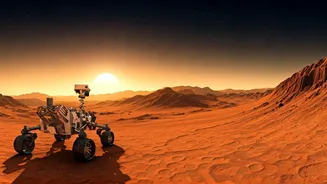
The consensus next destination is clear: Mars. But if the Moon is base camp, Mars is the summit of Everest—a challenge of an entirely different magnitude. The distances alone are staggering. A trip to the Moon takes about three days; a one-way journey to Mars takes six to nine months, and launch windows only open every 26 months when the planets align. This isn't just a longer road trip. It introduces immense complexities in propulsion, radiation shielding, and life support that make the lunar leap seem like a short hop. The Red Planet's thin atmosphere and greater gravity also make landing, famously described as the "seven minutes of terror," an aerospace nightmare. It's thick enough to create a fiery entry but too thin to sufficiently slow a spacecraft for a soft landing.
The Human Factor and Technological Hurdles
Beyond the mechanics of getting there, the greatest challenge is keeping astronauts alive. A multi-year Mars mission would expose a crew to significant space radiation outside the protection of Earth's magnetic field, increasing long-term health risks. Crews would need to be almost entirely self-sufficient, recycling water and oxygen and potentially growing their own food, as resupply missions are not feasible. Furthermore, the psychological strain of extreme isolation and confinement, coupled with a communication delay of up to 22 minutes each way, means astronauts must be able to solve problems autonomously without real-time help from Mission Control. Developing the closed-loop life support systems, robust radiation protection, and advanced propulsion to make this possible are the primary technical barriers that engineers are currently working to overcome.
India’s Ambitious Red Planet Plans
India, having already reached Mars orbit on its first attempt with the Mangalyaan mission in 2014, is setting its sights on a landing. The planned Mangalyaan-2 mission is a significant leap forward, aiming to place a lander, a rover, and even a helicopter on the Martian surface. This ambitious mission will test a host of new technologies, including a sky crane for landing the rover—a technique pioneered by NASA—and aerobraking to enter the Martian atmosphere. If successful, India would join an exclusive club of nations—the US and China—that have operated rovers on Mars. The mission is a crucial part of ISRO's broader vision, which includes the Gaganyaan human spaceflight program and the development of a national space station, the Bharatiya Antariksh Station. These initiatives are designed to build the domestic capability for long-duration and deep-space missions.
The Evolving Economics of Space
Financing such monumental undertakings requires a new economic model. The era of purely government-funded space exploration is giving way to a dynamic public-private ecosystem. The costs of interplanetary missions are astronomical, and governments are increasingly looking to commercial partners to drive innovation and reduce expenses. Companies like SpaceX have already revolutionized the launch industry with reusable rockets, and a similar disruption is needed for deep-space technologies. For India, developing missions like Mangalyaan-2 not only boosts national prestige but also stimulates the domestic space economy, which is projected to grow significantly. These ambitious projects spur innovation, create high-tech jobs, and inspire the next generation of scientists and engineers, providing a return on investment that goes far beyond the mission itself.