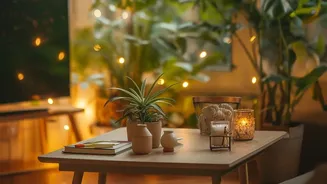







The Two-Fold Power of Light
In interior design, lighting is often called the final layer, the element that brings a room together. But its power goes far beyond mere illumination. For those in compact urban homes, strategic lighting is a transformative tool. It can manipulate our
perception of space, making a room feel more expansive than its measurements suggest. Simultaneously, the right kind of light can work in harmony with our body's natural rhythms, creating a sanctuary of calm that prepares us for rest. This isn't just design theory; it's a blend of environmental psychology and basic biology. By understanding how to wield light, you can address two of the most common challenges of modern apartment living without moving a single wall.
Creating the Illusion of Space
The common assumption that a brighter room feels like a bigger room is a myth. A single, harsh overhead light that illuminates every corner equally actually emphasizes a room's boundaries, making it feel smaller and more box-like. The secret to expanding a space is creating depth and contrast. Instead of uniform brightness, designers use multiple sources of warm light to create pools of illumination and soft shadows. This technique, known as 'light layering', draws the eye around the room, highlighting certain features while letting others recede. This variation makes the space more interesting and tricks the brain into perceiving it as larger and more dimensional.
Syncing With Your Evening Brain
Our bodies have an internal clock, or circadian rhythm, that is powerfully influenced by light. For millennia, human brains evolved to associate the bright, blue-toned light of day with alertness and the warm, amber glow of sunset and firelight with rest. Modern life, with its constant exposure to artificial lights and screens, often disrupts this natural cycle. Cool, blue-toned light, common in many standard LED bulbs, can suppress the production of melatonin, the hormone that signals to your brain it's time to sleep. Conversely, warm light with a colour temperature between 2200 and 3000 Kelvins mimics that evening glow, helping to reduce stress and promote relaxation, making the transition to sleep smoother.
Your Guide to Layering Light
Putting this into practice is simpler than it sounds. It revolves around combining three types of lighting. First is Ambient Light, the general, foundational light that makes a room usable, often from a ceiling fixture. Second is Task Light, which is focused illumination for specific activities like reading or cooking, provided by table lamps or under-cabinet lights. The third, and most often overlooked, is Accent Light. This is the 'magic' layer, used to highlight artwork, plants, or architectural details with spotlights or picture lights. In a small apartment, having these three layers on different switches allows you to tailor the atmosphere, moving from bright and functional during the day to soft and atmospheric in the evening. A good starting point for any room is to have at least three different light sources at varying heights.
Practical Placements for Small Homes
In a limited space, every fixture counts. Instead of a central ceiling light, consider a floor lamp that shines upward; this bounces light off the ceiling, making the room feel taller. Place a table lamp in a far corner to draw the eye diagonally across the room, creating a sense of greater depth. Wall sconces are excellent space-savers that provide both ambient and accent light without taking up floor or table space. In the kitchen, installing simple LED strips under the cabinets provides perfect task lighting while adding a sophisticated, layered look. The goal is to avoid a single point of failure and distribute light in a way that creates a rich, inviting, and visually dynamic environment.