


The Sun's Violent Outbursts
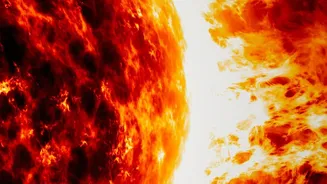
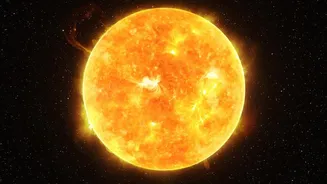
Our Sun is not the perfectly calm sphere it might appear to be. It's a turbulent star with a powerful magnetic field that sometimes snaps, unleashing tremendous energy. These events are primarily known as solar flares and coronal mass ejections (CMEs).
A solar flare is an intense burst of radiation that reaches Earth in about eight minutes. A CME, often following a flare, is a massive cloud of magnetised plasma and charged particles hurled into space, taking one to three days to reach our planet. While these events produce the beautiful auroras, they also pose a significant risk to the technological backbone of our society.
What's at Risk on Earth?
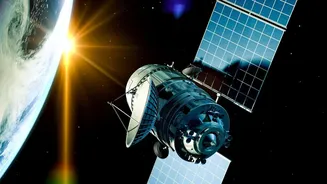
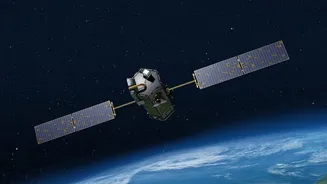
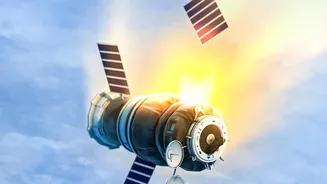
When a powerful CME interacts with Earth's magnetic field, it can induce geomagnetically induced currents (GICs) in long conductors on the ground. This is especially dangerous for high-voltage power grids, as the excess current can overload transformers, leading to widespread blackouts that could take months or longer to repair. Beyond the power grid, space weather poses a severe threat to our satellite fleet. The energetic particles can damage sensitive electronics, degrade solar panels, and increase atmospheric drag, causing satellites to lose altitude and re-enter the atmosphere uncontrollably. This affects everything from telecommunications and television broadcasting to critical GPS navigation, which can be distorted, impacting aviation, shipping, and precision agriculture.
Our Eyes Watching the Sun
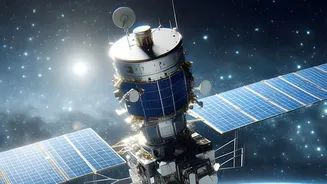
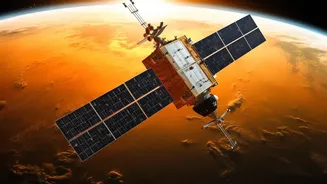
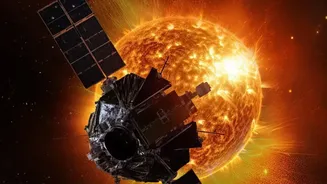
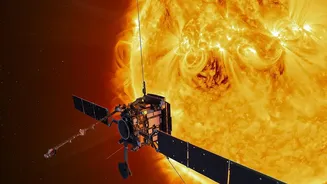
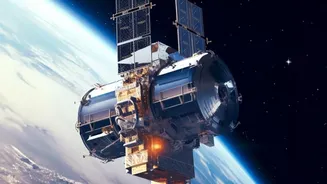
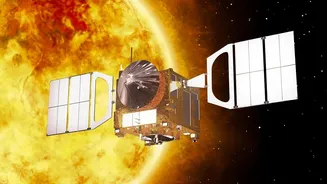
Continuous, real-time monitoring is the first line of defence. A network of space-based observatories and ground-based instruments acts as our early warning system. India's Aditya-L1 mission, for example, is strategically positioned at the Sun-Earth Lagrange Point 1 (L1), about 1.5 million kilometres from Earth. This vantage point provides an uninterrupted view of the Sun, allowing its seven scientific payloads to detect solar flares, analyse the solar wind, and track CMEs from their inception. Aditya-L1 joins an international fleet of solar sentinels, like NOAA's GOES and DSCOVR satellites, which also monitor the sun's activity and measure the solar wind in real-time. Together, they give us a crucial heads-up, turning a surprise attack into a predictable event.
From Solar Warning to Action
When satellites like Aditya-L1 detect an Earth-directed CME, space weather prediction centres, such as NOAA's SWPC, analyse the data and issue warnings. This warning time, ranging from hours to days, is critical. It allows infrastructure operators to take protective measures. Power grid operators can adjust their loads and prepare to disconnect sensitive equipment to prevent catastrophic overloads. Satellite operators can put their spacecraft into a protective 'safe mode', powering down non-essential components to minimise the risk of electrical failure from radiation. Airlines can reroute flights away from polar regions where radiation exposure is higher and radio blackouts are more likely during a solar storm. These proactive measures are essential for mitigating the worst effects of space weather.
Building a More Resilient Future
While monitoring and short-term mitigation are effective, the long-term goal is to build more resilient infrastructure. This involves 'hardening' critical systems by designing transformers and satellite components that are less vulnerable to the effects of space radiation and induced currents. Improved forecasting models, fed by the constant stream of data from our solar observatories, will also provide more accurate and timely warnings. By understanding the Sun's behaviour in greater detail, scientists and engineers can develop better engineering standards and operational strategies to ensure that even a major solar storm doesn't send us back to a pre-digital age. The constant vigilance of solar monitoring is an unseen shield that makes our technology-dependent world possible.