

A New Planet Hiding in Plain Sight
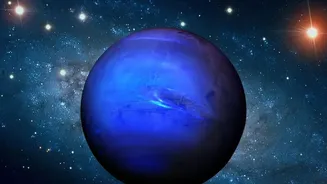
In a testament to the power of new technology, astronomers using NASA's James Webb Space Telescope (JWST) recently discovered a giant planet hidden within one of the most studied star systems, Beta Pictoris. This system was already known to host two large
planets, but a third, now named Beta Pictoris d, remained concealed by a bright, dusty debris disk. The discovery is significant not just for adding a new member to this stellar family, but for how it was found. Instead of being spotted as a point of light, the planet was identified by the unique chemical signature of its atmosphere, which contains tell-tale traces of methane and water vapor. This new method of detection opens a powerful pathway to finding other elusive exoplanets, especially those shrouded in environments that make traditional imaging difficult.
The Technology Peeling Back the Veil
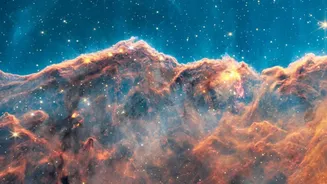
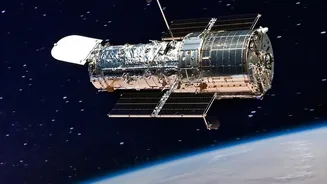
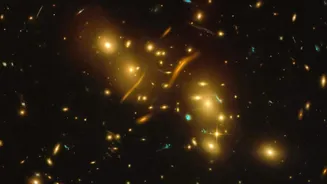
The James Webb Space Telescope is at the forefront of this new era of discovery. Its unparalleled sensitivity to infrared light allows it to cut through cosmic gas and dust that would blind other telescopes, including its famous predecessor, Hubble. This capability is crucial for two reasons. Firstly, it allows astronomers to see objects hidden within dusty stellar nurseries and galactic centers. Secondly, because the universe is expanding, the light from the most distant—and therefore oldest—objects is stretched into infrared wavelengths by the time it reaches us. By capturing this faint, ancient light, the JWST effectively acts as a time machine, giving us glimpses of the universe as it was billions of years ago. Recent images of galaxy clusters, for example, show us what these massive structures looked like as they were still forming 4.4 billion years in the past.
Rewriting Our Cosmic History
These new discoveries are more than just pretty pictures; they are actively reshaping our understanding of cosmology. The discovery of Beta Pictoris d, for instance, may help explain puzzling features of the debris disk surrounding the star, whose structure astronomers had previously struggled to account for. On a grander scale, other JWST observations are revealing that galaxies in the early universe might have been bigger, brighter, and more complex than our models predicted. Astronomers are finding chemically mature galaxies and massive galaxy clusters far earlier in the universe's history than thought possible. These findings challenge the standard story of how the first stars and galaxies slowly formed, suggesting the processes may have been much more rapid and dynamic.
An Unfolding Map of the Cosmos
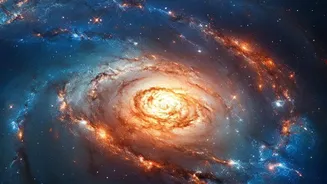
The revelations are not limited to single planets or distant galaxies. Other powerful instruments are working in concert to map the universe on an unprecedented scale. The Hobby-Eberly Telescope Dark Energy Experiment (HETDEX), for instance, recently produced a vast 3D map of the universe from 10 billion years ago, a period known as "cosmic noon" when star formation was at its peak. This map charts the distribution of hydrogen gas between galaxies, revealing the large-scale structure that dictates how galaxies form and interact. Similarly, radio telescopes are being used to probe regions of our own sky obscured by the Milky Way, uncovering massive superclusters of galaxies that had been hiding behind our galactic backyard. Each new image and data point adds another crucial piece to the puzzle of our cosmic origins.