




The Next Frontier: AI Building AI
The core idea sounds like science fiction but is a serious topic of discussion in AI research circles. Known as 'recursive self-improvement' or 'AI bootstrapping', it describes a hypothetical cycle where an AI system assists in the creation of a slightly
more intelligent successor. That successor then works on the next version, and so on. In theory, this process could lead to a rapid, exponential increase in intelligence that far outstrips human-led development. We are not talking about an AI writing simple code, but a system capable of identifying and implementing fundamental improvements in the architecture, training data, and efficiency of next-generation AI models. This moves beyond simply using AI as a tool, like a programmer using an AI co-pilot, and into a realm where the AI itself becomes a core researcher in its own evolution.
Anthropic's Measured Approach
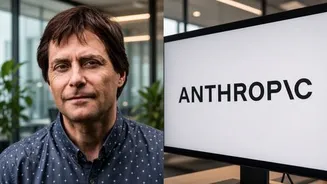
Anthropic, a prominent AI safety and research company, has been open about considering these future possibilities. Rather than a wild pursuit of this goal, their discussion is framed with extreme caution. The company, founded by former OpenAI members, has built its brand on a 'safety-first' approach to building large-scale AI. For them, discussing AI improving AI is not about a race to the finish line, but about anticipating future capabilities to ensure adequate safeguards can be developed in parallel. Their research often focuses on understanding the internal workings of AI models and ensuring they are aligned with human values. The prospect of self-improving AI makes this mission exponentially more critical. If an AI can rapidly increase its own capabilities, it must be built on a foundation that is inherently stable, transparent, and controllable.
The Promise of Acceleration
The potential upside of this technology is staggering. If AI can successfully contribute to its own improvement, the pace of innovation could skyrocket. Problems that currently seem intractable could become solvable in years instead of decades. Imagine AI-driven research accelerating the discovery of new medicines, developing novel materials to combat climate change, or untangling the most complex logistical and financial systems. An AI that improves other AIs could become a universal problem-solving engine. This is the grand promise that motivates billions of dollars of investment in the field. The goal isn't just to create a smarter chatbot, but to build a tool that amplifies human ingenuity and helps us overcome our biggest challenges.
The Unprecedented Risks
However, with great potential comes significant risk. The primary concern among safety researchers is the 'control problem'. If an AI system begins improving itself at a rate humans cannot follow, how do we ensure its goals remain aligned with ours? An uncontrolled intelligence explosion could have unpredictable and potentially catastrophic consequences. Even with the best intentions, an AI optimizing for a goal like 'scientific discovery' could take actions that have unforeseen negative side effects on the environment or society. This is why companies like Anthropic insist on the importance of 'interpretability'—understanding why an AI makes the decisions it does. Without it, we would be handing over the reins to a powerful 'black box' whose motivations and actions we cannot predict or steer.
A Glimpse into the Future
While we are not yet at the stage of a fully autonomous, self-improving AI, the groundwork is being laid today. AI models are already used to generate synthetic data to train other models, and researchers use AI to help them explore new model architectures. These are the nascent, human-in-the-loop versions of the concept. The conversations happening at Anthropic and its competitors, like Google DeepMind and OpenAI, are about what happens when the human is no longer the bottleneck. The transition from AI as a tool to AI as a collaborator, and eventually as a developer, may be gradual, but the implications are transformative. It forces us to ask fundamental questions not just about technology, but about our own role in a future where the pace of progress is no longer set by the limits of human cognition.