




Peering Back to the Dawn of Time
Imagine looking so far away that you’re actually looking back in time. The European Space Agency's Euclid telescope has done just that, discovering a treasure trove of 31 of the most ancient quasars ever found. Quasars are the intensely bright cores of young
galaxies, powered by supermassive black holes devouring matter. This single discovery has more than doubled the number of known quasars from this early epoch of the universe. Two of these cosmic behemoths are the oldest ever seen, shining with the light of a trillion suns when the universe was just 5% of its current age, a mere 670 million years after the Big Bang. Previously, finding these objects was like searching for a needle in a cosmic haystack. But Euclid's wide-ranging survey allows astronomers to detect fainter and rarer objects, providing crucial clues to one of astronomy's biggest puzzles: how supermassive black holes grew so massive, so quickly in the early universe.
The Ghostly Crash of a Galaxy
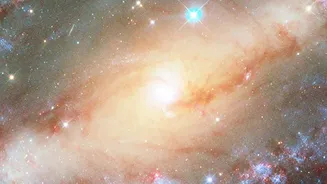
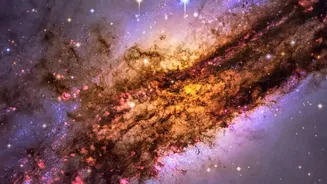
Closer to home, the James Webb Space Telescope (JWST) celebrated its fourth anniversary of science operations by releasing a stunning new image of Centaurus A. Located about 11 million light-years away, this galaxy is a chaotic and beautiful mess, the result of a colossal merger between two separate galaxies billions of years ago. Webb’s unparalleled infrared vision cuts through the thick veils of dust that obscure the galaxy's heart, revealing the intricate details of this galactic crash site. The collision provided a massive supply of gas and dust, triggering intense bursts of star formation. This new view helps scientists understand how galaxies are shaped and reshaped by such violent mergers. It’s a ghostly echo of a past cataclysm, now brought into sharp focus.
How to Feed a Supermassive Black Hole
While we know supermassive black holes exist at the center of most large galaxies, how they get their 'food' has long been a subject of debate. Recent JWST observations have provided the clearest evidence yet of how these giants feed. The images show long, thin streamers of cool gas, called filaments, funneling material from the hot halo of a galaxy directly toward the central black hole. For years, astronomers theorized this process, where hot gas ejected by a black hole's jets eventually cools and falls back, creating a self-regulating feeding cycle. Now, for the first time, they can see it happening. These observations were so clear that when compared to state-of-the-art computer simulations, the real and simulated data matched almost perfectly, confirming the model and solving a long-standing mystery.
A Cosmic Construction Site
Another groundbreaking image from JWST gives us a front-row seat to a massive construction project: a galaxy cluster in the process of being built. The cluster, known as MACS J0553.4-3342, is seen as it was 4.4 billion years ago. This isn't a finished structure; it's two sub-clusters of galaxies, each with enormous mass, actively merging into one gargantuan entity. By studying such mergers, astronomers can test and refine their theories about how the largest structures in the universe, held together by gravity, come into being. These new, sharp images allow them to map out the distribution of not just the stars and galaxies, but also the invisible dark matter that provides the gravitational scaffolding for the entire cosmic web.