



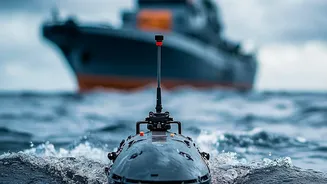
The global shipping industry is on the cusp of an autonomous revolution. But how do you safely test a self-driving ship? Researchers at IIT Madras have developed a groundbreaking solution called SeaNav to tackle this very problem.
The High-Stakes World of Ship Testing
Autonomous vessels promise
a future of safer, more efficient maritime transport, a critical goal for an industry that handles over 80% of global trade. However, developing the artificial intelligence for these ships presents a massive hurdle. Testing new navigation algorithms on a real vessel in open water is incredibly expensive, logistically complex, and fraught with risk. A single software bug could endanger marine ecosystems, other vessels, and valuable cargo. This challenge has been a significant bottleneck, slowing down the deployment of next-generation maritime technology that could prevent accidents and streamline supply chains.
SeaNav: A Digital Twin for the High Seas
Enter SeaNav, a state-of-the-art platform developed by the Department of Ocean Engineering at IIT Madras. Think of it as a hyper-realistic video game for self-driving ships. At its core, SeaNav is a 'digital twin' platform. It creates a high-fidelity virtual maritime environment where everything from ocean waves and vessel movements to sensor behaviour and dense ship traffic can be simulated in real-time. This allows engineers to test their autonomous navigation systems rigorously in a safe, controlled, and cost-effective digital space before they ever touch the water. The system was built using the Unity3D engine and calibrated using a 320-meter benchmark tanker, ensuring the simulations closely mirror real-world operations.
How It Builds a Virtual Reality
SeaNav goes beyond simple simulation. It incorporates advanced sensor fusion, AI, and even virtual reality (VR). A key innovation is its ability to model realistic sensor limitations. Unlike idealised simulators, SeaNav can introduce noise, delays, and other imperfections that mimic how real-world sensors perform in difficult conditions like fog, heavy rain, or low light. This forces the AI to learn how to navigate reliably even when its 'senses' are impaired. Furthermore, the platform includes an immersive VR interface using Meta Quest headsets, allowing human operators and trainees to experience the simulation from the ship's bridge, providing invaluable training for collision avoidance and emergency manoeuvres.
Powering India's Maritime Vision
The development of SeaNav is a significant milestone for India's ambitions in the maritime sector. The project aligns perfectly with national initiatives like the 'Sagarmala Programme' and 'Maritime India Vision 2030', which call for the adoption of smart port technologies and digital solutions. According to Dr. Suresh Rajendran, an Associate Professor in the Department of Ocean Engineering at IIT Madras, the platform provides a scalable way to develop and validate autonomous technologies. Its potential applications extend beyond commercial shipping to include coastal surveillance, search-and rescue operations, and maritime defence. The system is poised to help strengthen safety and efficiency at major Indian ports such as Chennai, Mumbai, Visakhapatnam, and Kochi.