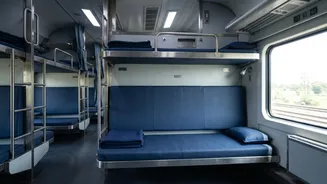







Securing a lower berth on a long train journey is a game-changer for comfort, especially for senior citizens and families. While IRCTC's allotment is automated, a few smart checks during booking can tilt the odds significantly in your favour.
1. Master Your Basic Berth Preference
The most
fundamental step is often overlooked in the rush to book. On the 'Passenger Details' page, IRCTC provides a 'Berth Preference' dropdown for each traveller. Always select 'Lower' from this menu. While it acts as a request rather than a command, it is the primary instruction you give to the Passenger Reservation System (PRS). The system's algorithm first considers these preferences against available seats. If you don't specify a preference, the system will assign any available berth, removing your first and best chance to influence the outcome. This is particularly crucial if you book early when more berths are unassigned, giving the preference logic more room to work. For senior citizens (men aged 60+ and women aged 45+), this selection works in tandem with the automatic priority the system gives them for the lower berth quota.
2. Use the 'Lower Berth' Quota & Conditions
Beyond a simple preference, IRCTC offers powerful conditional booking options. Look for checkboxes like 'Book only if at least one lower berth is allotted' or 'Book only if two lower berths are allotted'. Selecting one of these makes your entire booking conditional. If the system cannot allocate at least one lower berth at the time of booking, the transaction will not proceed, and your money will not be deducted (or will be fully refunded if it has been). This is a non-negotiable way to avoid being assigned an unsuitable upper or middle berth. It is the most definitive tool for travellers for whom a lower berth is a necessity, not just a preference. Be aware that this might mean you don't get a ticket at all on a busy train if no lower berths are free, but it prevents the disappointment of an unwanted allotment.
3. Ensure Passenger Details are Flawless
The IRCTC system uses passenger data, specifically age and gender, to automatically apply certain quotas. Indian Railways reserves a specific number of lower berths in Sleeper, 3AC, and 2AC coaches for senior citizens, women aged 45 and above, and pregnant women. For male passengers aged 60 and above and female passengers 45 and older, the system automatically prioritises them for a lower berth, subject to availability. To take advantage of this, you must enter the correct age and gender. An incorrect birth year is a common reason eligible passengers miss out on this automatic priority. The IRCTC's 'Master List' feature is excellent for this; it allows you to save passenger details accurately once, so they can be applied flawlessly to all future bookings without the risk of a typo.
4. Strategise Your Booking Group
The number of people on a single PNR can affect berth allocation logic. According to railway staff, the automatic lower berth priority for senior citizens works best when booking for one or two eligible passengers at a time. If you book for a larger group that includes three or more senior citizens on a single ticket, the algorithm may struggle to assign lower berths to all of them, even if they are eligible. A savvy approach for a group of four senior citizens, for instance, would be to split the booking into two separate PNRs of two passengers each. While this carries a small risk of the groups being in different coaches, it significantly increases the probability of the senior citizen quota being applied successfully to each smaller group, securing those coveted lower berths.