



A Sweet Discovery in a Cosmic Cloud
Deep in the cosmos, about 27,000 light-years from Earth, lies a vast and chaotic molecular cloud of gas and dust known as Sagittarius B2. This region, near the supermassive black hole at our galaxy’s center, is a stellar nursery, a place where new stars
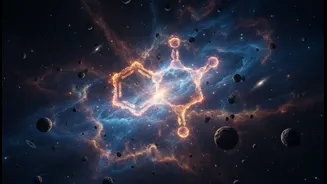
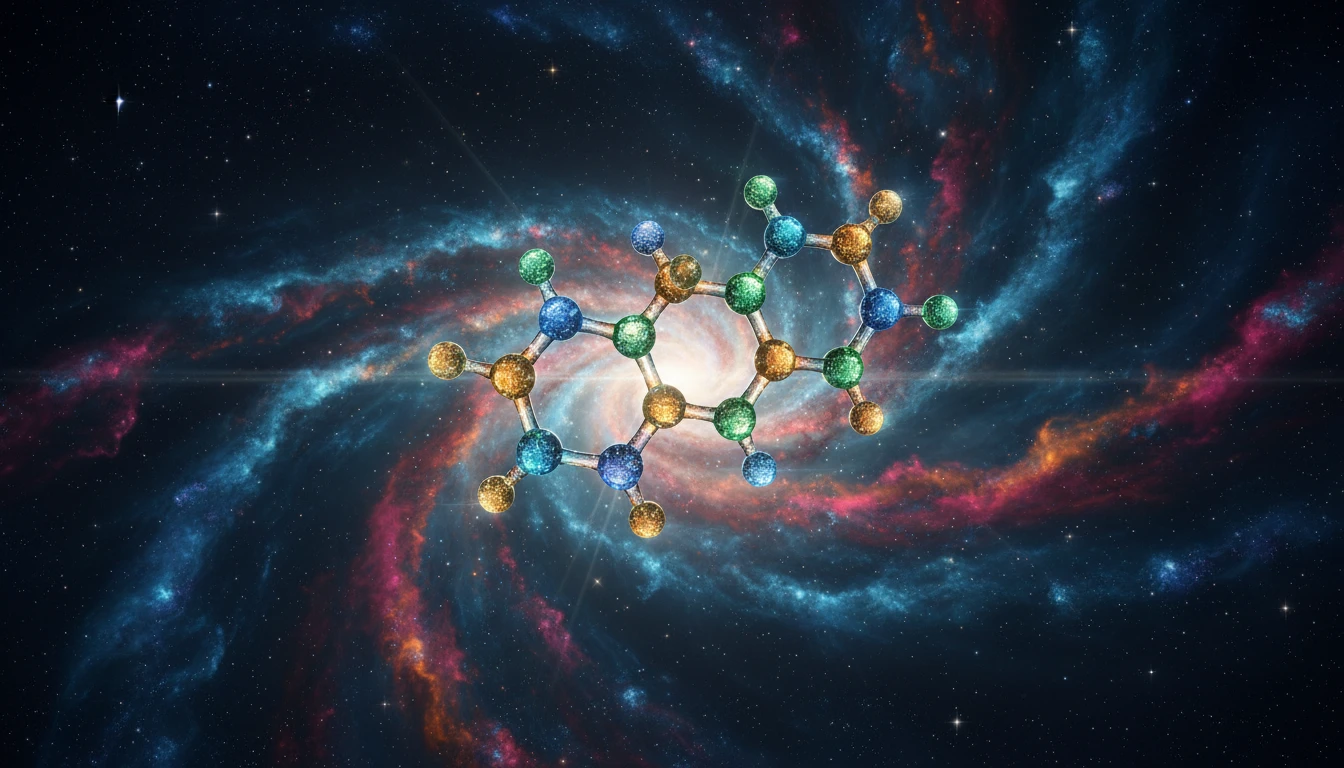
are born. Using powerful radio telescopes, astronomers have peered into this dense cloud and found something remarkable: the chemical signature of simple sugars. One of the first key discoveries was glycolaldehyde, the simplest sugar-related molecule. More recently, in July 2026, researchers confirmed the presence of erythrulose, a four-carbon sugar also found in raspberries, marking the first time a true sugar had been detected in interstellar space. These aren't just random chemicals; they are considered prebiotic molecules, the raw ingredients that could eventually give rise to life.
The Building Blocks of Biology
While finding sugar in space sounds like a cosmic novelty, its significance is profound. On Earth, sugars are fundamental to life. They are not just a source of energy; they form the structural backbone of our very genetic code. The ‘R’ in RNA (ribonucleic acid) and the ‘D’ in DNA (deoxyribonucleic acid) stand for ribose and deoxyribose—both of which are complex sugars. The simpler sugars found in Sagittarius B2, like glycolaldehyde and erythrulose, are crucial precursors. They are the foundational pieces from which more complex molecules like ribose can be built. Their presence in an interstellar cloud suggests that the fundamental components for life aren't unique to planets but can form naturally in the cold, harsh environment between stars, long before planets even exist.
A Cosmic Puzzle of 'Handedness'
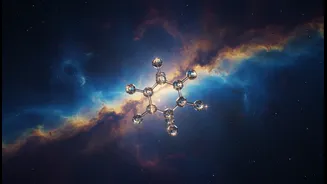
One of the deepest mysteries related to the origin of life is a property called chirality, or 'handedness'. Many crucial biological molecules, including sugars and amino acids, can exist in two forms that are mirror images of each other, much like your left and right hands. Although chemically identical, they are not interchangeable. Intriguingly, life on Earth exclusively uses right-handed sugars (like ribose in DNA) and left-handed amino acids. Why this preference exists is unknown, but scientists call it homochirality, and it is essential for biological structures like the double helix of DNA to function correctly. The discovery of a chiral molecule called propylene oxide in Sagittarius B2 was a landmark moment. While astronomers couldn't tell if it was the left- or right-handed version, its mere existence in space opens the door to the possibility that some process in interstellar space gives one 'hand' a slight advantage, which could then be passed on to developing planets.
From Stardust to a Living Planet
So, how could a sugar molecule formed in a distant gas cloud find its way to a young Earth? The leading theory is that comets and asteroids act as cosmic delivery trucks. These celestial bodies formed from the same primordial cloud of gas and dust that created our solar system. As they travel through space, they can accumulate these complex organic molecules. For billions of years, comets and asteroids have bombarded planets, including our own. It's plausible that these impacts seeded the early Earth with a rich supply of prebiotic ingredients, including sugars and amino acids, that were cooked up in interstellar space. Rather than starting from scratch in a primordial soup, life on Earth may have had a significant head start, thanks to this cosmic seeding.
A Universe Ripe for Life?
The detection of these crucial organic molecules thousands of light-years away has profound implications. It suggests that the chemical conditions necessary for life are not a rare fluke but may be commonplace throughout the galaxy. If the building blocks of life are widely distributed, it raises the tantalising possibility that life itself could emerge on other worlds. This discovery doesn't prove the existence of extraterrestrial life, but it strengthens the argument that the universe is chemically primed for it. The same processes that may have led to life on Earth could be unfolding in countless other planetary systems that are forming right now. The ingredients are out there, scattered among the stars.