




A Familiar Cosmic Laboratory
For decades, the Beta Pictoris system has been a go-to subject for astronomers. Located a relatively close 63 light-years from Earth, it’s a young and dynamic stellar neighborhood. Its star is surrounded by a bright disk of dust and debris, providing
a rare real-time window into how planetary systems are born. Until now, scientists were confident they knew its main tenants: two massive gas giants named Beta Pictoris b and Beta Pictoris c. The former was famous in its own right as one of the very first exoplanets to ever be directly photographed. The system was considered a benchmark, a well-understood model against which other, more mysterious systems could be compared. It was, by all accounts, a settled case.
Meet the New Neighbor: Beta Pictoris d
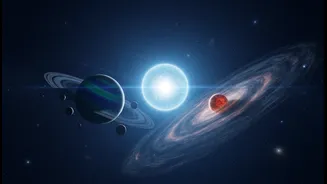
The latest discovery adds a third giant to the family: Beta Pictoris d. This newfound world is a gas giant with about 2.4 times the mass of Jupiter, making it the smallest of the three known planets in the system. It occupies the widest orbit, circling its star at a distance comparable to Neptune’s in our own solar system. But its most remarkable feature is how it managed to stay hidden for so long. For over a decade, it was playing what one astronomer called a cosmic game of “hide-and-seek.” The planet is incredibly faint — in fact, it’s the faintest exoplanet ever to be directly imaged from Earth. It was lost in the blinding glare of its parent star and often obscured by the light from its much brighter sibling planet, Beta Pictoris b.
How Webb Found the Ghost in the Machine
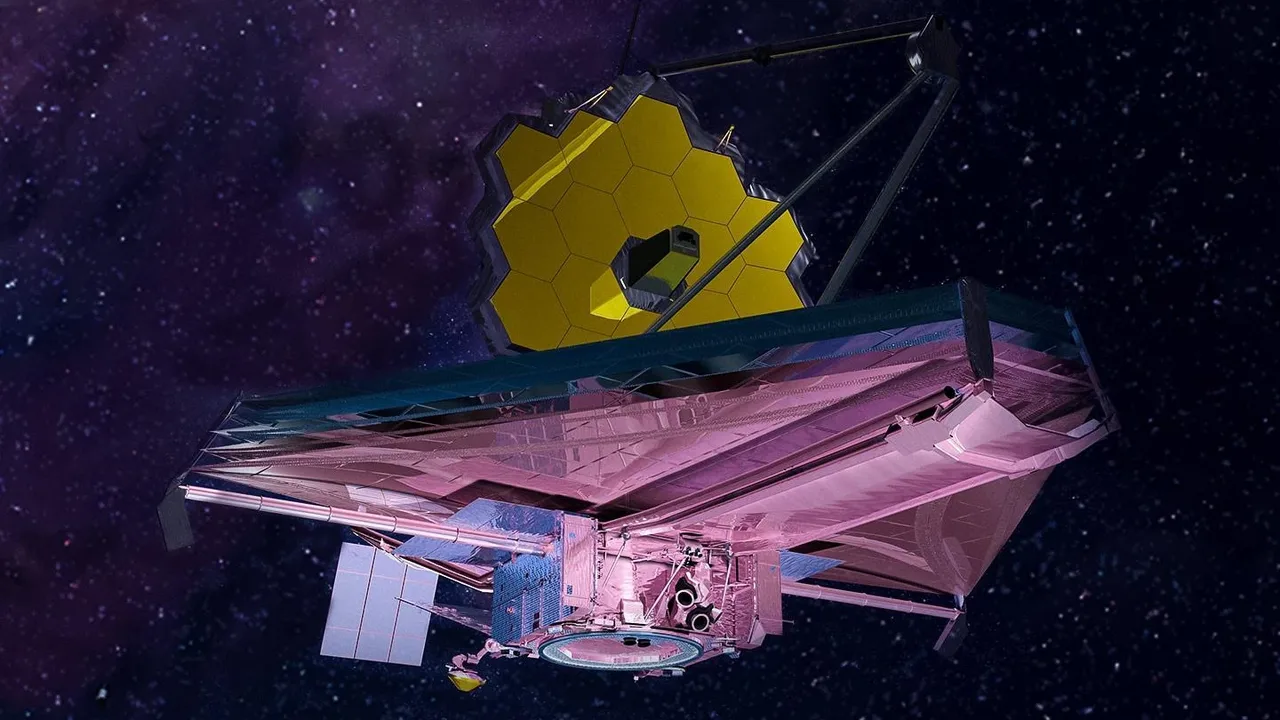
Unmasking Beta Pictoris d required a technological team effort, showcasing the power of modern astronomy. One team of scientists first spotted the planet using the European Southern Observatory's Very Large Telescope in Chile. They then sifted through 11 years of archival data, including observations from the James Webb Space Telescope (JWST), to confirm its existence and track its motion. However, a separate team using the Webb telescope made the discovery in a completely different, and arguably more revolutionary, way. While studying the other planets, they didn't find Beta Pictoris d by seeing its faint dot of light. Instead, they found it by detecting the unique chemical fingerprint of its atmosphere. Webb’s powerful Near-Infrared Spectrograph (NIRSpec) identified a distinct pattern of carbon monoxide, a signature consistent with a giant planet’s atmosphere, allowing them to confirm its presence, speed, and position without ever needing to resolve it as a bright point.
A New Toolkit for Discovery
This dual-method discovery highlights a significant return on the massive technological investment that is the JWST. The telescope's primary mirror and advanced instrumentation were designed for exactly this kind of challenge: finding the unfindable. The ability to detect a planet solely by its atmospheric composition is a game-changer. It means that future searches for exoplanets won't be limited to finding bright, obvious worlds. Scientists can now hunt for planets that are too faint, too close to their star, or otherwise too difficult to photograph directly. By analyzing the light that passes through or is emitted from a planet’s atmosphere, Webb can identify worlds by what they are made of, not just by where they are. This technique could dramatically accelerate the discovery of new worlds, including those that might have conditions suitable for life.
The Universe Is More Crowded Than We Knew
The discovery of Beta Pictoris d does more than just add another planet to the catalog. It fundamentally alters our understanding of a system we thought we knew inside and out. If a planet this large could remain hidden in one of the most intensely studied star systems, it raises an exhilarating question: what else are we missing? It suggests that even our closest cosmic neighbors might be hiding secrets. The finding implies that planetary systems may be more crowded than our previous tools could reveal. Each new discovery validates the sophisticated technology powering modern astronomy and reinforces the idea that the universe still has countless surprises waiting to be uncovered.