









The Crisis Beneath Our Feet
India is the world's largest user of groundwater, extracting more than any other nation. This invisible resource supplies about 50% of the water needs in urban areas, but our reliance has pushed it to a breaking point. Cities like Delhi, Bengaluru, Chennai,
and Hyderabad are among the most water-stressed globally. In and around Hyderabad, for instance, groundwater levels plummeted by nearly seven metres in just one year between September 2025 and 2026. Across the country, hundreds of assessment units are now classified as 'over-exploited', meaning more water is drawn out than nature can replenish through rainfall. This over-extraction is driven by a combination of rapid urbanisation, which covers natural ground with concrete, and the increasing water demands of a growing population.
From Taps to Tankers
For urban residents, this isn't an abstract problem. It translates into intermittent municipal supply, a growing dependence on expensive private water tankers, and the daily uncertainty of whether the tap will run dry. The crisis deepens social inequality, as poorer households often pay significantly more for tanker water. Furthermore, as water tables drop, the quality of the remaining water often degrades, with increasing levels of contaminants like nitrates, fluoride, and even lead in some areas. This dual threat of scarcity and contamination makes the search for alternative, reliable water sources a matter of household necessity and economic survival.
Necessity Sparks a Revolution
It is this very pressure that is fuelling a quiet revolution in household water management. Faced with an unreliable supply and high costs, urban homeowners and communities are no longer waiting for large-scale government projects to solve their problems. This has created a massive, bottom-up demand for solutions that are affordable, easy to install, and effective at a local level. The focus is shifting from centralised infrastructure to decentralised systems that empower individuals. This necessity has become the mother of invention, giving rise to a new market for simple, 'do-it-yourself' (DIY) and 'plug-and-play' rainwater harvesting technologies that were previously considered niche or overly complex.
The New Wave of Harvesting
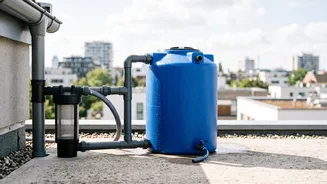
Unlike traditional rainwater harvesting systems that require significant civil work and space, new innovations are designed for modern urban homes. Startups and social enterprises are leading the charge. For example, Gujarat-based NeeRain has developed patented, compact filters that can be easily attached to a building's existing downpipes, requiring no special labour or large pits. These 'plug-and-play' systems filter out debris and channel clean rainwater directly into storage tanks or borewells for groundwater recharge. Other simple yet effective methods include modular underground storage tanks that can be installed under parking spaces, DIY kits using basic materials like PVC pipes and mesh filters, and even systems that integrate with rooftop gardens. These solutions are often incredibly cost-effective, with basic systems costing as little as a few thousand rupees.
More Than Just Saving Water
The impact of these household-level innovations extends far beyond individual homes. Every litre of rainwater captured is a litre less drawn from strained municipal supplies or depleted aquifers. This reduces household water bills and lowers the electricity costs associated with pumping groundwater. On a community scale, widespread adoption of rainwater harvesting helps mitigate urban flooding by capturing runoff that would otherwise overwhelm storm drains. Most importantly, when this harvested water is used to recharge borewells, it actively helps replenish the very groundwater sources we have been depleting, contributing to long-term water security for the entire community. It represents a fundamental shift in mindset—from being passive consumers of water to becoming active stewards of a precious resource.