




The Fuel Problem in Space
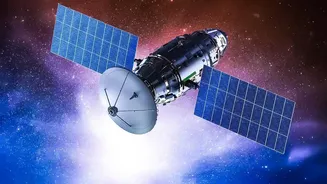
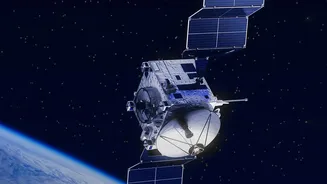
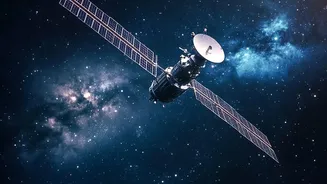
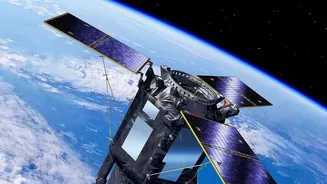
A satellite’s life is dictated by the amount of propellant it can carry. Conventional satellites use chemical propellants for initial orbit insertion and subsequent station-keeping maneuvers to counteract gravitational pulls and maintain their precise
position. Once this fuel runs out, the satellite’s mission is effectively over. It becomes another piece of space debris or is deorbited. This finite lifespan has massive economic implications. It means operators must constantly plan, build, and launch costly replacement satellites. Furthermore, the propellant itself is heavy, significantly increasing the mass of the satellite and, consequently, the cost of launching it into space.
A Breath of Fresh Air for Satellites
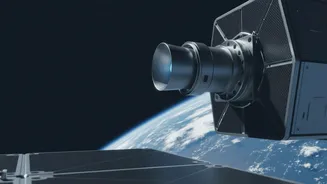
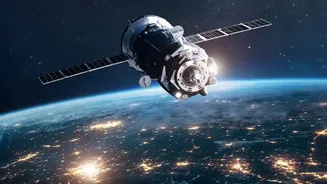
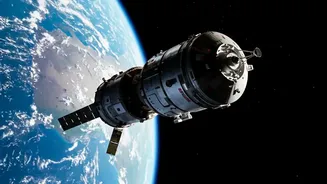
Air-breathing electric propulsion (ABEP), also known as air-scooping electric propulsion, offers a radical solution to this problem. Instead of carrying a finite supply of fuel, an ABEP-equipped satellite uses the residual atmosphere in Very Low Earth Orbit (VLEO) as its propellant. VLEO, the region roughly 150 to 400 kilometers above Earth, has just enough atmospheric particles—mostly atomic oxygen—to be collected and used. This concept, first proposed in the 1960s, is now on the cusp of becoming a reality thanks to advances in electric propulsion and materials science.
How It Actually Works
The principle behind ABEP is elegantly simple. A satellite travelling at orbital speeds—around 8 kilometers per second—scoops up the sparse atmospheric particles through a specially designed intake. These captured particles are then channeled into an electric thruster. Powered by the satellite’s solar panels, the thruster ionizes the particles (gives them an electric charge) and then accelerates them out of an exhaust nozzle at high velocity. This process generates a small but continuous thrust. While the thrust is low compared to chemical rockets, it is more than enough to perfectly counteract the atmospheric drag experienced in VLEO, allowing the satellite to maintain its orbit indefinitely without using any onboard propellant.
The VLEO Advantage
The development of ABEP is intrinsically linked to the growing interest in VLEO. Operating satellites closer to Earth offers significant benefits. For Earth observation and remote sensing, a lower altitude means higher-resolution imagery without needing larger, more expensive optics. For telecommunications, it reduces latency, providing faster and more responsive connectivity. However, VLEO has always been a challenging domain because the increased atmospheric drag causes rapid orbital decay. ABEP technology transforms this primary challenge into a feature, using the drag-inducing particles as an inexhaustible fuel source. This makes sustained, long-duration missions in VLEO not just possible, but economically attractive.
The Business Case for 'Unlimited' Fuel
For satellite operators, the shift to ABEP is a strategic business decision. By eliminating the need for propellant, the operational lifetime of a satellite is no longer limited by its fuel tank, but by the durability of its electronic components. This could extend mission durations from a few years to potentially decades. Launch costs are also reduced because the mass saved from not carrying fuel can be used for more revenue-generating payload or simply result in a lighter, cheaper-to-launch satellite. The technology enables persistent surveillance, continuous connectivity, and improved climate monitoring from VLEO—services that were previously difficult or too expensive to provide. It also has a sustainability benefit: at the end of its life, an ABEP satellite can simply be switched off, and the natural atmospheric drag will cause it to deorbit and burn up, mitigating the growing problem of space debris.
Hurdles and Horizons
Despite the immense promise, ABEP technology is still in its early stages and faces significant technical hurdles. Designing an intake that efficiently collects particles in a rarefied and variable atmosphere is a major challenge. The thrusters themselves must be robust enough to operate using corrosive atomic oxygen instead of pristine xenon gas. Several government agencies and private companies, including the European Space Agency (ESA), DARPA, and startups like Phase Four and Viridian Space, are actively developing and testing these systems. As these technological challenges are overcome, ABEP is poised to transition from research and development into operational deployment.