



India’s Vantage Point in Space
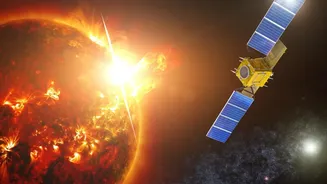
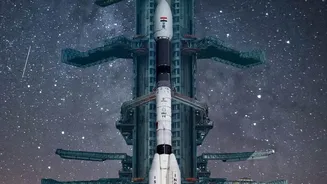
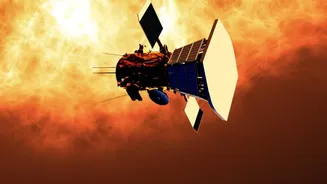
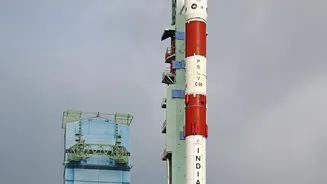
Launched in September 2023, ISRO's Aditya L1 is India's first dedicated mission to study the Sun. It is strategically positioned in a halo orbit around the Lagrange point 1 (L1), about 1.5 million kilometres from Earth. This unique location gives it an uninterrupted,
24/7 view of the Sun, free from the eclipses or occultations that hinder ground-based observation. While its primary goal is to unravel solar mysteries like coronal heating, a key function is to act as an early-warning system for space weather, and it is already delivering on that promise.
The Threat of Solar Storms
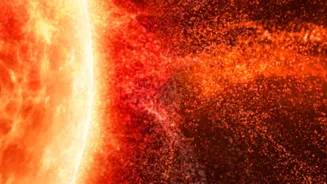
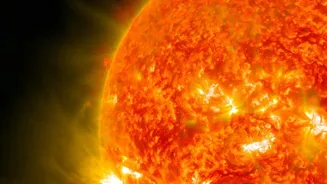
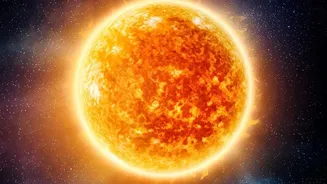
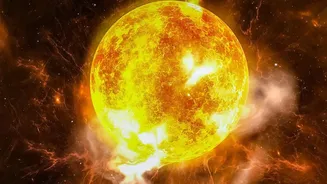
Our Sun is not always the calm, life-giving star it appears to be. It frequently unleashes powerful bursts of energy and matter known as solar flares and Coronal Mass Ejections (CMEs). When a CME, a massive cloud of magnetised plasma, hurtles towards Earth, it can cause a geomagnetic storm. These storms have the potential to cripple our modern world by disrupting satellite communications, damaging power grids, interfering with GPS navigation, and posing a risk to astronauts in space. As our reliance on technology deepens, the need to accurately forecast these events becomes more critical than ever.
A Breakthrough in Early Detection
Recent findings from Aditya L1 have provided scientists with unprecedented insights into the very birth of CMEs. Using the Visible Emission Line Coronagraph (VELC) payload, researchers have captured the first-ever spectroscopic signatures of a CME's onset phase, very close to the Sun's surface. In one significant observation, the VELC instrument tracked a CME on July 16, 2024, noting key changes that act as precursors. Researchers observed a dimming of the Sun's corona, a 30% increase in temperature, and heightened turbulence in the region just before the eruption. These are exactly the kinds of tell-tale signs needed for a predictive model.
The Instruments Making It Possible
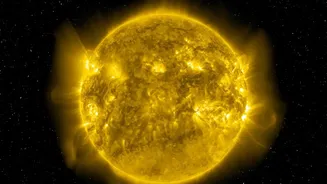
This breakthrough is a testament to the sophisticated suite of seven instruments aboard Aditya L1. The VELC instrument, developed by the Indian Institute of Astrophysics, is crucial for studying the corona. Another key payload, the Solar Ultraviolet Imaging Telescope (SUIT), has captured never-before-seen images of solar flare kernels in the near-ultraviolet (NUV) wavelength, filling a major data gap in solar physics. Meanwhile, in-situ instruments like the Aditya Solar wind Particle Experiment (ASPEX) and the Plasma Analyser Package for Aditya (PAPA) directly measure the solar wind and its properties, providing the ground truth for what is heading our way.
Improving Global Space Weather Forecasts
The data from Aditya L1 isn't just about observation; it's about building better, more reliable predictive models. By understanding the specific changes in temperature, density, and velocity of plasma just before and during an ejection, scientists can refine their forecasts. For example, measuring the electron density of a CME helps differentiate it from the surrounding corona, giving a clearer picture of its structure and potential impact. This ability to capture the initial lift-off of a CME provides a crucial head-start, improving the lead time for warnings issued to satellite operators and power grid managers on Earth.