




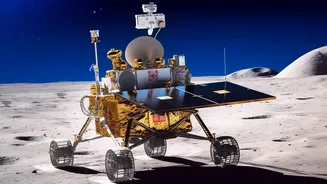
The Problem with Moon Dust
One of the greatest obstacles to a long-term lunar presence is the very ground astronauts will walk on. The Moon is covered in a layer of fine, sharp, and abrasive soil called regolith. During the Apollo missions, this dust proved to be a persistent nuisance,
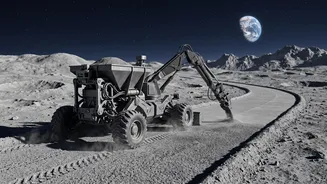
clogging machinery, eroding spacesuits, and posing a health hazard. A more significant danger arises during landings and takeoffs. With no atmosphere and weak gravity, rocket engine plumes can blast this regolith outwards at high velocities, effectively sandblasting any nearby equipment, habitats, or personnel. Building stable landing pads and roads is not a luxury; it's a critical safety requirement to mitigate the dust problem and ensure the longevity of expensive equipment.
Enter the Robotic Workforce
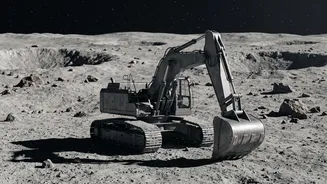
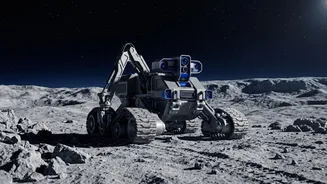
Transporting building materials like steel and concrete across 250,000 miles of space is prohibitively expensive. The solution is to use what's already there through a process called In-Situ Resource Utilization (ISRU). This is where robotic builders come in. Various projects funded by NASA, including the Moon to Mars Planetary Autonomous Construction Technology (MMPACT) project, are developing systems for robots to build structures before humans even arrive. These machines are designed to operate for long periods in the harsh lunar environment, which includes extreme temperature swings and a 2.6-second communication delay with Earth that makes direct remote control impractical. This push towards autonomy is seen as essential for reducing risk and freeing up valuable astronaut time for scientific discovery.
How to Pave the Moon
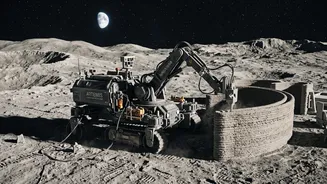
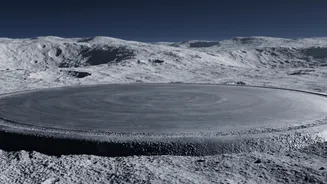
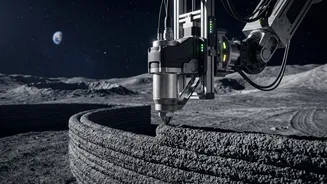
Several ingenious methods are being tested to turn loose regolith into solid surfaces. One leading technique involves using a powerful laser or concentrated solar energy to melt or 'sinter' the top layer of dust, fusing it into a glass-like, solid pavement. Researchers have demonstrated that this can create durable surfaces capable of supporting rover traffic. Another approach involves 3D printing. Companies like ICON, under a NASA contract, are developing systems to mix regolith with polymer binders to print structures layer by layer, including landing pads and habitats. NASA has also developed interlocking pavers that could be mass-produced from lunar materials and assembled by robotic systems, creating an exceptionally stable surface that prevents exhaust gases from eroding the soil underneath.
A Team of Builders
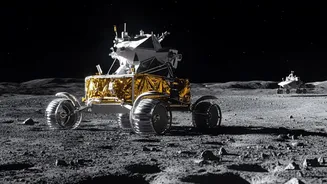
Building a landing pad is a multi-step process involving surveying, digging, hauling, and construction, which requires a team of specialized robots. NASA's Cooperative Autonomous Distributed Robotic Exploration (CADRE) project, scheduled to land on the Moon in 2026, will test how a trio of small, suitcase-sized rovers can work together as an autonomous team. While their initial mission is mapping, the technology demonstrates the potential for swarms of robots to collaborate on complex tasks. Future construction scenarios envision a fleet of machines: some rovers might survey the site with LiDAR, others could excavate and transport regolith, and larger platforms could handle the final paving or printing. This division of labor, coordinated by shared software, allows the robotic team to adapt to challenges and work efficiently without constant human oversight.
The Road Ahead
While significant progress has been made in labs and simulated environments, no robotic construction machine has operated on the Moon yet. There are still major hurdles to overcome, such as designing hardware that can survive the extreme cold of the two-week lunar night and dealing with potential maintenance issues far from Earth. However, the roadmap is clear. NASA and its commercial partners envision a staged approach, beginning with small-scale demonstrations and progressing to the construction of landing pads, roads, and protective berms. Projects like NASA's DiLE-ARCon aim to demonstrate these capabilities by 2028. These early robotic missions won't build an entire base overnight, but they will lay the literal groundwork, preparing a safe and functional site for the eventual arrival of astronauts.