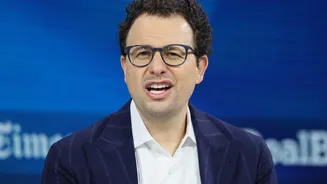








In the high-stakes, hyper-competitive world of artificial intelligence, one company emerged from its biggest rival. This is the story of how siblings Dario and Daniela Amodei built Anthropic on a foundation of principle, not just profit.
A Departure of Principle
The story of Anthropic
begins with a departure. In late 2020, several key figures from OpenAI, the research lab behind ChatGPT, decided to leave. At the heart of this group were siblings Dario Amodei, OpenAI's Vice President of Research, and Daniela Amodei, its VP of Safety and Policy. They weren't chasing a bigger payday or a fancier title. Instead, their exit was driven by a fundamental disagreement over the future of AI development. Dario, in particular, had developed a specific vision for how to build and scale AI responsibly, and he felt it was becoming 'incredibly unproductive' to argue for it from within an organization with a different vision. He believed that as AI models grew more powerful, safety couldn't be an afterthought; it had to be the central design principle. Convinced they needed a clean slate to pursue this safety-first mission, they, along with a handful of other colleagues, walked away to build something new.
The Genesis of Anthropic
In 2021, the Amodeis and five other former OpenAI employees founded Anthropic. They established it as a public benefit corporation, a structure that legally obligates them to balance shareholder profits with a public good—in this case, 'the responsible development and maintenance of advanced AI for the long-term benefit of humanity'. From the outset, the mission was clear: to treat AI safety as a scientific discipline and build systems that were helpful, honest, and harmless. This wasn't just marketing language; it was a direct response to their concerns that the race for AI capabilities was outpacing the research into its control and alignment with human values. The founding team, which included top researchers, brought with them a wealth of experience in training large-scale AI models, giving the young company instant credibility in a field dominated by giants.
Building a 'Constitutional' AI
Anthropic's flagship product is Claude, a family of AI models designed to compete with the likes of ChatGPT. But its key differentiator lies in how it's trained. The company pioneered a technique called 'Constitutional AI'. Instead of relying exclusively on extensive human feedback to prevent harmful outputs, Anthropic's method involves giving the AI a 'constitution'—a set of principles and rules to follow. These principles are drawn from sources like the UN's Universal Declaration of Human Rights. During training, the model learns to critique and revise its own responses based on this constitution, effectively teaching itself to be safer. This approach aims to make the AI's behavior more predictable and its decision-making more transparent, reducing the risk of it generating toxic, biased, or dangerous content while also being less evasive than some safety-filtered models.
Securing Powerhouse Status
A safety-first mission is noble, but in the world of AI, it requires immense capital for computing power and top talent. Anthropic proved masterful at securing it. The company has attracted billions in investments, most notably from tech titans Amazon and Google. These deals weren't just about cash; they were strategic partnerships that provided Anthropic with the critical cloud infrastructure needed to train its massive models. In exchange, Amazon and Google gained a significant stake in a leading AI innovator, integrating Claude into their own cloud service offerings. This flood of funding rapidly transformed Anthropic from a principled startup into a bona fide industry powerhouse, valued in the hundreds of billions and capable of competing at the very highest level.
The Sibling Dynamic at the Helm
At the center of this meteoric rise is the unique leadership structure of the Amodei siblings. They have divided their roles to avoid overlap and maximize efficiency. Dario, as CEO, serves as the company's 'ideological leader' and chief researcher, focusing on the long-term technical vision. He is the public face of their safety-first philosophy. Daniela, as President, runs the day-to-day operations. She manages the executive team, scales the organization, and oversees everything from business strategy to policy engagement. This clear division of labor has allowed them to steer a company that grew from a small team to over a thousand employees while navigating the immense pressures of the AI arms race, all while keeping their foundational mission in sight.