


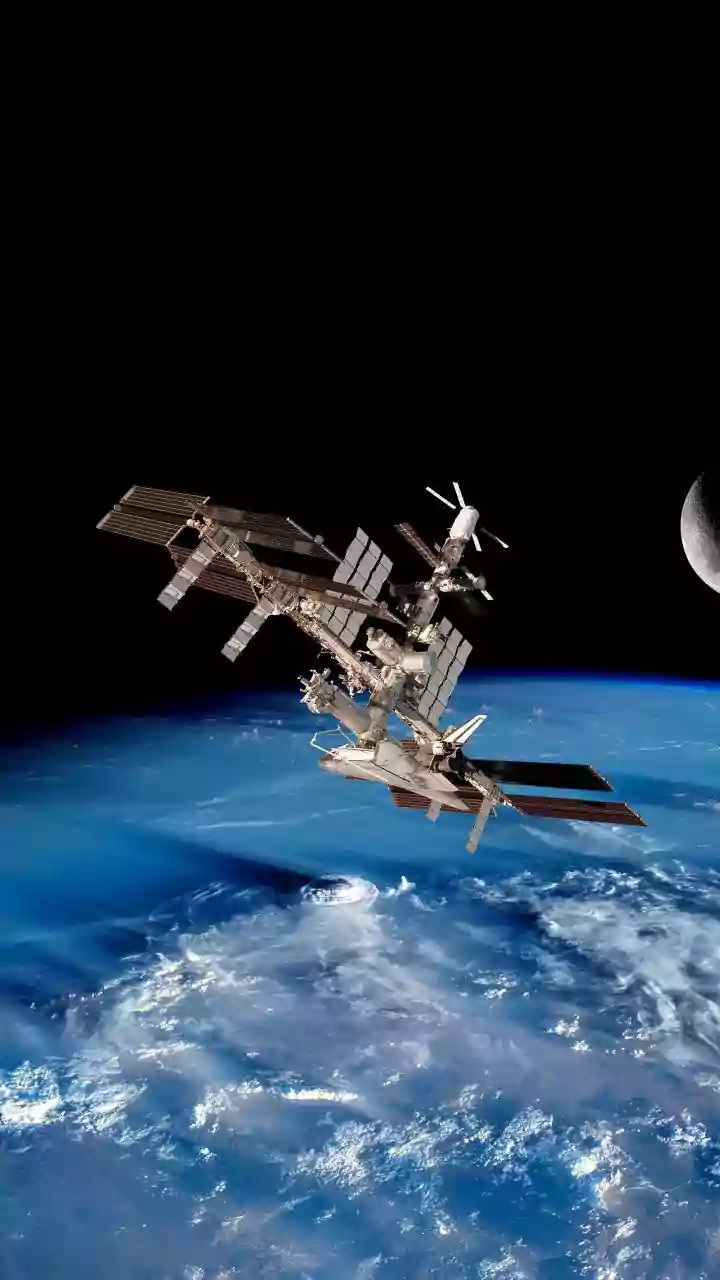






A Day in 90 Minutes
Imagine your entire day—from dawn to dusk and back to dawn—compressed into just 90 minutes. That is the reality for crew members aboard the International Space Station (ISS). Traveling at a staggering 28,000 kilometres per hour, the station completes
a full orbit of Earth in roughly an hour and a half. This incredible speed is necessary to maintain its orbit, constantly falling toward Earth but moving so fast horizontally that it continually misses. The result of this orbital dance is a rapid-fire sequence of day and night. For every 24-hour period on Earth, the astronauts aboard experience about 16 of these cycles. This means they witness a sunrise or sunset approximately every 45 minutes, a relentless and beautiful rhythm that fundamentally redefines the concept of a 'day'.
The Challenge to the Human Clock
While visually spectacular, this rapid cycling of light and dark poses a significant challenge to human biology. Our bodies are governed by circadian rhythms, internal clocks fine-tuned over millennia to a 24-hour cycle of light and dark here on Earth. In space, these natural cues are gone, replaced by a pattern that can wreak havoc on an astronaut's sleep, metabolism, and overall well-being. Sleep disruption is one of the most common issues reported by astronauts, who often average only six hours of sleep despite being scheduled for eight. To combat this, NASA and other space agencies have developed strict schedules based on Coordinated Universal Time (UTC) and installed advanced LED lighting systems that shift in color and intensity to mimic a terrestrial day, helping to trick the body's clock into a more normal rhythm.
A View That Changes Everything
For space enthusiasts, the 16-sunrise fact is captivating because it’s a gateway to imagining the astronaut’s experience. The visual spectacle is hard to overstate. Astronauts describe an orbital sunrise not as a slow, gentle event, but as a sudden, explosive arrival of light. A thin blue line appears on the horizon, quickly bursting into vibrant layers of colour as the Sun leaps over the Earth's curve in seconds. But the effect is more than just visual; it’s profoundly psychological. Witnessing the Earth from this vantage point, with its visible atmosphere as a fragile, thin line, often triggers a cognitive shift known as the 'Overview Effect'. It’s a feeling of awe, connection to humanity, and an overwhelming sense of the planet’s beauty and fragility.
The Overview Effect
Coined by author Frank White, the Overview Effect describes the powerful change in perspective reported by many astronauts. From orbit, political borders vanish. The conflicts and divisions that seem so significant on the ground become invisible, replaced by the sight of a single, unified planet. Astronauts often return to Earth with a deeper appreciation for our world and a renewed sense of responsibility to protect it. The 16 daily sunrises are a constant, repeating reinforcement of this perspective. Seeing the entire planet cycle through day and night over and over again transforms an abstract concept—a globe—into a living, breathing system. It is this profound shift, from seeing Earth as a collection of places to seeing it as a singular, shared home, that lies at the heart of the Overview Effect.
A Symbol of Human Ingenuity
Ultimately, the love for the 16-sunrise fact comes from what it represents. It’s a neat, digestible summary of an incredible feat of engineering and human ambition. It embodies the strangeness and wonder of leaving our home planet. That we have created a habitat where humans can live in an environment so alien that the sun rises every 90 minutes is a testament to our curiosity and drive. The fact encapsulates the challenges—from managing biological rhythms to the extreme temperature swings the station endures as it passes from sunlight to shadow—and the sheer beauty of space exploration. It bridges the gap between science fiction and reality, reminding us that we are a species that looks up at the sky and dreams of what lies beyond.