






Who's Minding the Kitchens?
The responsibility for your train meal is shared among several bodies. The Indian Railway Catering and Tourism Corporation (IRCTC) is the primary entity tasked with managing catering services, from base kitchens on the ground to pantry cars on moving
trains. It sets policies, manages vendors, and is the face of the service. Supporting this is the Food Safety and Standards Authority of India (FSSAI), which mandates the hygiene and quality rules that all railway caterers must follow. Every vendor, from a large base kitchen to a small stall, must have an FSSAI license. Zonal Railways also play a role in overseeing static units like food plazas at stations. Finally, a multi-layered inspection system involving Railway officials, IRCTC staff, and designated Food Safety Officers conducts both scheduled and surprise checks to enforce these standards.
From Base Kitchen to Your Berth
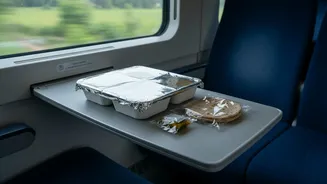
The journey of a train meal is designed for safety and consistency. Most meals served on long-distance trains are not cooked in the pantry car. Instead, they are prepared in large, modernised 'base kitchens' located at strategic points across the rail network. Indian Railways has been upgrading these kitchens, installing CCTV cameras for real-time monitoring of food preparation, which in some cases can be viewed online by passengers. The focus is on using branded raw materials and ensuring hygienic preparation under the supervision of Food Safety Supervisors. Once cooked, meals are packed and transported to the trains. Some premium trains like the Rajdhani and Shatabdi have on-board pantry cars for final preparation and serving, while others rely entirely on these pre-prepared meals. This system is intended to centralise quality control and reduce the variability that comes with on-the-go cooking.
When the System Goes Off-Track
Despite the framework, problems persist. Common passenger complaints include poor quality ingredients, cold food, unhygienic handling, and overcharging. Enforcement is a significant challenge; inspecting a constantly moving network is difficult, and while penalties are in place, their effectiveness is a subject of debate among passengers. Between 2023 and 2026, Indian Railways imposed fines of ₹5.13 crore and terminated six catering contracts for violations, demonstrating that an enforcement mechanism exists. However, with an average of 58 crore meals served annually, even a small percentage of issues can affect a large number of travellers. The sheer scale of the operation—spanning thousands of trains and millions of passengers daily—makes 100% compliance a constant and formidable challenge.
Your Rights as a Passenger
As a passenger, you are not powerless. Your first line of defense is information. Since recent changes, many meal packets come with a QR code. Scanning this can reveal details like the kitchen name, date of packing, and the FSSAI license number. This helps verify the source of your food. If you encounter any issues—be it poor quality, overcharging, or unhygienic conditions—you have multiple channels for redressal. The quickest way is often through the 'Rail Madad' portal or app, or by calling the helpline number 139. You can also tweet your complaint to @RailwaySeva for a real-time response. Be sure to have your PNR number handy. For non-urgent matters, you can use the toll-free number 1800-111-321 specifically for catering complaints.
The Way Forward: Tech and Transparency
Indian Railways and IRCTC are increasingly leveraging technology to improve food safety. Beyond the live streaming of kitchens and QR codes on food packets, third-party audits are regularly conducted to provide an unbiased assessment of pantry cars and base kitchens. There is also a push to offer passengers more choice through e-catering services, allowing them to order from a variety of FSSAI-approved local restaurants at upcoming stations via apps. The system of checks and balances is also being strengthened with the deployment of dedicated on-board IRCTC supervisors and Food Safety Supervisors at kitchens. These measures signal a shift towards greater accountability and a more passenger-centric approach to onboard dining.