


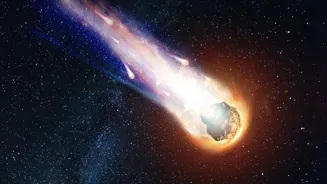
Finding a Moving Needle in a Cosmic Haystack
The first step in identifying a space rock is simply spotting it. Astronomers use powerful ground-based and space telescopes to continuously scan the sky. Projects like the Catalina Sky Survey and Pan-STARRS take multiple images of the same patch of sky several
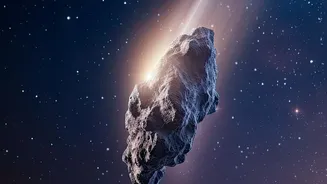
minutes apart. Software then compares these images, searching for any 'star' that has moved. While the background stars and galaxies remain fixed, an asteroid or comet will appear as a tiny speck of light that has shifted its position. Once a potential moving object is flagged, it's added to a confirmation list for other astronomers—both professional and amateur—to observe. These follow-up observations are crucial for calculating a preliminary orbit and determining if the object is a Near-Earth Object (NEO) that requires closer monitoring.
What's It Made Of? A Rainbow of Clues
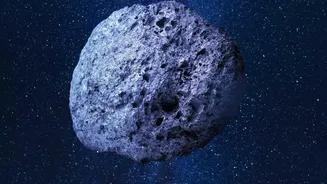
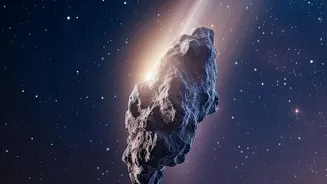
Once an object's path is tracked, the next question is: what is it made of? Researchers use a technique called spectroscopy, which analyzes the light reflecting off the asteroid's surface. Just as a prism splits white light into a rainbow, a spectrograph breaks down the asteroid's reflected sunlight. Different minerals absorb and reflect specific wavelengths of light, creating a unique spectral 'fingerprint'. By analyzing which colours are missing or enhanced, scientists can infer the rock’s surface composition. This is how they classify asteroids into broad categories. The most common are C-type (carbonaceous), which are dark and rich in carbon, clay, and organic molecules; S-type (silicaceous), which are stony and made of silicate materials and nickel-iron; and M-type (metallic), which are composed mostly of nickel and iron. These classifications provide vital clues about where in the solar system the asteroid formed.
Determining Size: It's Not Just About Brightness
Figuring out an asteroid's size is trickier than it seems. An object that appears faint in visible light could either be very small and reflective, or very large and dark. To solve this puzzle, scientists also observe the asteroid in infrared light. An object's brightness in the infrared spectrum is related to the heat it radiates, which is directly linked to its surface area. By combining visible light data (how much light it reflects) with infrared data (how much heat it emits), researchers can calculate both its size and its albedo, which is the measure of its reflectivity. For instance, a small but shiny S-type asteroid might reflect the same amount of visible light as a large, dark C-type asteroid, but their infrared signatures will reveal their true sizes.
When Space Rocks Come to Earth
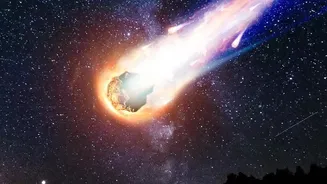
Sometimes, a piece of an asteroid survives a fiery journey through our atmosphere and lands on Earth as a meteorite. Identifying these terrestrial finds involves a different set of checks. One of the first clues is the presence of a fusion crust—a thin, dark, glassy layer formed when the rock's exterior melted during its descent. Meteorites are also typically much denser and heavier than Earth rocks of a similar size because most contain metallic iron. This composition means that the majority of meteorites will stick to a magnet, a key field test for meteorite hunters. In a lab, scientists can confirm a rock’s extraterrestrial origin by analyzing its mineral composition for specific structures like chondrules—tiny, spherical grains that formed in the early solar system and are not found in terrestrial rocks.
Putting It All Together: From Discovery to Knowledge
Each piece of information—orbit, composition, size, and albedo—helps build a complete profile of a space rock. This classification is crucial for two main reasons. First, it helps in planetary defense. By identifying and tracking potentially hazardous objects, agencies like NASA's Planetary Defense Coordination Office can assess any potential impact risk to Earth. Second, it advances our scientific understanding of the solar system. For example, C-type asteroids are like time capsules, their composition closely matching the primordial nebula from which the sun and planets formed. Studying them, either remotely through telescopes or directly through sample-return missions, allows us to piece together the 4.6-billion-year-old story of our cosmic neighborhood.