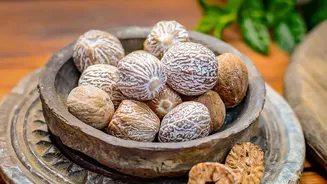







The Spice We Know and Love
Nutmeg, the seed of the Myristica fragrans tree native to Indonesia, has a storied history, once being more valuable than gold. In India, it's a key ingredient in many garam masalas, biryanis, and traditional sweets. Its warm, sweet flavour enhances both
savoury and sweet dishes. Beyond its taste, it's been used in folk remedies for centuries to aid digestion and sleep. It contains antioxidants and has antibacterial properties, making it seem like a wholly beneficial spice.
The Science Behind the Danger
The secret to nutmeg's potent flavour and its potential toxicity lies in a compound called myristicin. Myristicin is a naturally occurring substance found in the essential oil of the nutmeg seed. While it is present in other plants like dill and parsley, nutmeg contains the highest concentration. In small culinary amounts, it's perfectly safe. However, in larger doses, the way our body metabolises myristicin changes, affecting the central nervous system. This mechanism is what leads to the spice's psychoactive and toxic effects.
What Happens When You Have Too Much?
Nutmeg poisoning is a serious and deeply unpleasant experience. Symptoms can appear within three to eight hours of ingestion and can last for more than a day. Initial effects often include severe nausea, dizziness, extreme dry mouth, and a rapid heart rate. As the toxicity progresses, it can affect the central nervous system, leading to hallucinations, confusion, agitation, and feelings of detachment or paranoia. People who have experienced it often describe it as a long, harrowing 'hangover' that can last for two days, with none of the euphoria associated with other substances.
How Much is Too Much?
This is the most crucial question for home cooks. The good news is that it’s nearly impossible to reach a toxic level through normal cooking. Most recipes call for just a pinch or, at most, half a teaspoon of ground nutmeg. Toxic symptoms can begin to appear after ingesting around 5 grams, which is roughly two teaspoons of the ground spice. Doses of 10 to 15 grams are associated with more severe neuropsychological symptoms. Incidents of nutmeg poisoning are rare and typically involve either accidental ingestion by children or deliberate attempts by adolescents to experience a high, often unaware of the severe and dangerous side effects.
A History of Misuse
The psychoactive properties of nutmeg are not a new discovery. Its use as a hallucinogen has been recorded for centuries, with wealthy Europeans in the 16th and 17th centuries adding it to drinks for its mind-altering effects. In more modern times, it gained notoriety as a 'prison drug', as described in Malcolm X's autobiography, where it was used as a substitute for other narcotics. More recently, dangerous social media 'nutmeg challenges' have periodically emerged, encouraging risky behaviour among young people who are often ignorant of the potential for severe poisoning.