





The Unforgiving Lunar Night
The Moon has no atmosphere to trap heat, so when the Sun sets, the temperature plummets. During the two-week-long lunar night, surfaces can reach an unimaginable -173° Celsius, and in some permanently shadowed craters at the poles, it gets even colder.
For a sophisticated piece of machinery like a rover, this is a death sentence. Batteries lose their ability to hold a charge, sensitive electronics can fail, and metal components can become brittle and fracture. Without a way to stay warm, a billion-dollar mission could end the moment darkness falls. While solar panels are great for generating power during the lunar day, they are useless at night, leaving rovers vulnerable.
The Constant, Gentle Heat Solution
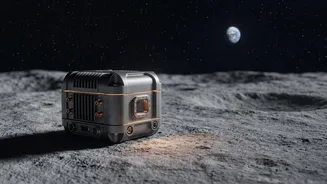
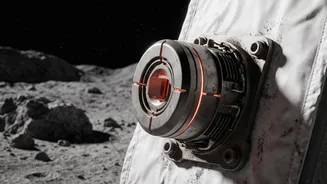
The primary solution to this deep-freeze problem is a technology called a Radioisotope Heater Unit, or RHU. These are not power generators in the way you might think; they don't produce electricity. Instead, their sole purpose is to generate a small, steady amount of heat. Think of them not as a power plant, but as a tiny, long-lasting campfire packed into a rugged shell. By strategically placing these RHUs around a rover's critical components—like the battery and computer systems—engineers can keep them within their operational temperature range, even when the outside environment is cryogenically cold. This allows the rover to hibernate safely through the dark, ready to wake up when the Sun rises again.
How It Works: The Simplicity of Decay
The genius of an RHU lies in its simplicity. It contains a small pellet of a radioactive material, typically plutonium-238, about the size of a pencil eraser. As this material naturally decays, it releases heat. There are no moving parts, no complex electronics, and no chemical reactions to manage. The heat is a constant, reliable byproduct of physics. Each RHU produces about one watt of thermal energy, which doesn't sound like much, but it's enough to make a critical difference. The plutonium pellet is encased in multiple layers of extremely durable materials, including iridium and graphite, designed to withstand launch failures or reentry, ensuring the radioactive material remains safely contained.
From Heaters to Full Power Systems
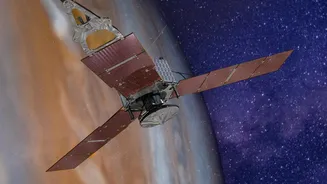
This same basic technology is scaled up to create full-fledged power systems. A Radioisotope Thermoelectric Generator (RTG) uses larger blocks of the same heat-producing material, called General Purpose Heat Source (GPHS) modules. But instead of just radiating heat, an RTG uses thermocouples to convert that heat directly into electricity. This is how missions to the outer solar system, like Voyager and New Horizons, have been powered for decades, far from the Sun. Mars rovers like Curiosity and Perseverance use a GPHS-powered RTG for both electricity and to keep their systems warm. Essentially, the same principle that provides a little warmth for lunar survival can be expanded to become the primary power source for some of humanity's most ambitious missions.
The Future of Lunar Exploration
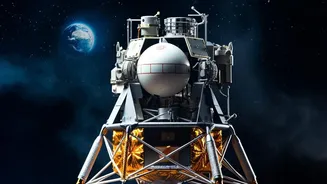
As NASA and its commercial partners, like Firefly Aerospace, plan for a sustained human and robotic presence on the Moon, this technology is more critical than ever. The ability to survive the lunar night is non-negotiable for long-term science stations, infrastructure, and future moon bases. While some missions are experimenting with advanced batteries and insulation to survive without nuclear heat, RHUs remain a proven, reliable method. Recent announcements show that companies like Zeno Power are developing RHUs for commercial lunar landers scheduled for missions later this decade, demonstrating that this decades-old technology is a cornerstone of future exploration. These simple, robust heaters make it possible to establish a lasting foothold on the Moon and, eventually, beyond.