




India's Next Interplanetary Quest
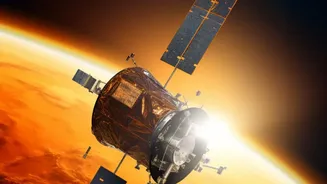
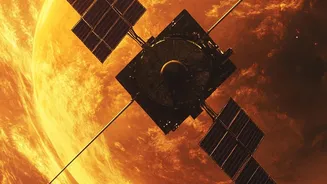
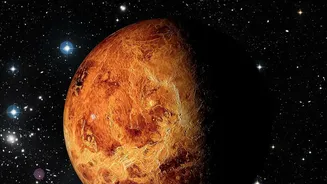
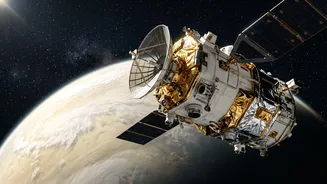
Following the historic successes of the Chandrayaan moon missions and the Mangalyaan Mars orbiter, the Indian Space Research Organisation (ISRO) is setting its sights on our other planetary neighbour. The Venus Orbiter Mission, officially named Shukrayaan-1,
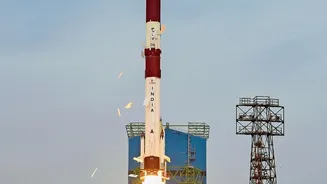
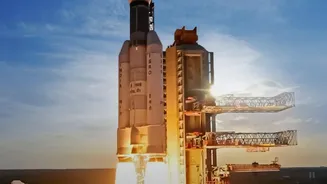
represents India’s second journey to another planet. Formally approved by the government in September 2024, the mission is currently slated for a March 2028 launch aboard the powerful LVM-3 rocket. This four-year mission aims to conduct a comprehensive investigation of Venus from orbit, studying everything from its volcanic surface and sub-surface geology to its complex, super-rotating atmosphere. Shukrayaan-1 is not just a scientific endeavour; it is a statement of India's growing prowess in deep space exploration, building on the legacy of its previous, highly successful missions.
The Enigma of the Venusian Clouds
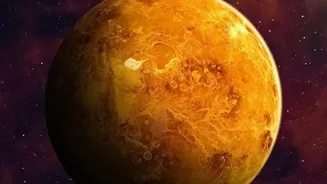
For decades, scientists have been puzzled by Venus’s atmosphere. Its thick clouds are primarily made of corrosive sulfuric acid droplets, completely hiding the surface from view and contributing to a runaway greenhouse effect that makes the surface hot enough to melt lead. But there are deeper mysteries. Scientists have been unable to identify the substance that causes strange, dark patches visible only in ultraviolet light. Some research suggests the presence of iron-bearing minerals like rhomboclase and acid ferric sulfate could be responsible. More tantalizingly, unconfirmed detections of phosphine gas have sparked debate about the possibility of unknown chemical processes or even microbial life floating in the more temperate upper cloud layers. Shukrayaan-1’s primary goal is to address these long-standing questions about the planet's atmospheric chemistry and dynamics.
A Toolkit for a Hostile World
To probe a world as inhospitable as Venus, ISRO has equipped Shukrayaan-1 with a suite of 19 advanced scientific instruments, or payloads. The payload, weighing around 100 kg, includes contributions from international partners like Russia, France, Sweden, and Germany, making it a global scientific collaboration. A key instrument is a high-resolution Synthetic Aperture Radar (SAR), which has the power to pierce through the dense clouds and map the planet’s surface with up to four times the resolution of NASA’s Magellan mission from the 1990s. For the first time ever on a Venus mission, it will also carry a ground-penetrating radar to investigate the planet's subsurface layers. Other specialised sensors will 'sniff' the atmosphere to determine its precise chemical makeup. Notably, the VIRAL instrument, a collaboration with Russia and France, is designed to study atmospheric gases, including looking for confirmation of phosphine.
What ISRO Hopes to Discover
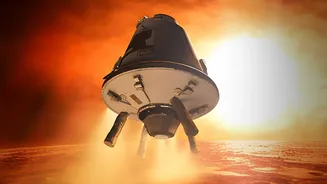
The mission's objectives are multifaceted. By mapping the surface and subsurface, ISRO hopes to find evidence of active volcanism and other geological processes that have shaped the planet. Understanding why Venus, a planet so similar in size and mass to Earth, evolved into such a hostile inferno is a key goal. The data gathered could provide crucial insights into how planetary climates evolve, including the runaway greenhouse effect, which has important implications for understanding climate change on our own planet. The orbiter will also study the interaction between Venus's ionosphere and the solar wind, helping scientists understand why the planet lost any water it may have once had. The mission will also be a crucial technology demonstrator for ISRO, particularly in its use of aerobraking—using the friction of the Venusian atmosphere to gradually lower its orbit—to conserve fuel.
A New 'Renaissance' of Venus Exploration
ISRO is not alone in its renewed interest in Venus. The late 2020s and early 2030s are set to become a golden age for Venus exploration. NASA has two missions planned, VERITAS and DAVINCI, while the European Space Agency (ESA) is developing its EnVision orbiter. These missions are all targeting launch windows around the same period, creating a coordinated global effort to unlock the planet's secrets. Shukrayaan-1, with its unique payload including the ground-penetrating radar, is poised to make a significant and complementary contribution to this international fleet. It cements India's position as a key player in the global space community, ready to tackle some of the solar system's biggest scientific mysteries.