







A Drone for a Distant World
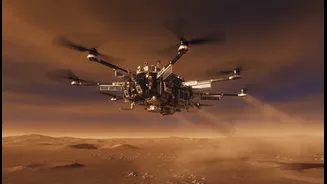
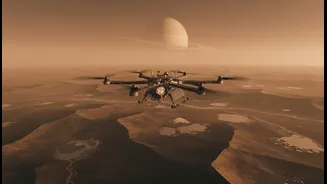
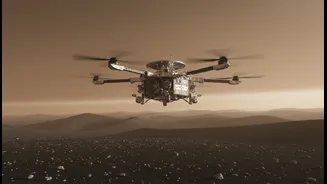
NASA's Dragonfly is not a typical rover. It's a car-sized, dual-quadcopter—an octocopter—designed to fly through the thick atmosphere of Saturn's largest moon, Titan. Scheduled for launch in July 2028, it will embark on a long journey, arriving at Titan in 2034.
Once there, it will become the first powered, controlled aircraft to fly on another moon. Unlike rovers, which are limited by terrain, Dragonfly will perform a series of 'hops,' flying for several kilometers at a time to explore dozens of different locations. Powered by a Multi-Mission Radioisotope Thermoelectric Generator (MMRTG), the same kind of nuclear power source used on the Mars rovers, Dragonfly can operate in Titan's extreme cold and dim light, where solar power is not an option. Its mission is to survive and operate for over three years on the surface, revolutionizing how we explore alien worlds.
Why Titan is So Compelling
Titan is one of the most intriguing bodies in our solar system. It is the only moon with a dense atmosphere, primarily nitrogen like Earth's but with a thick, organic-rich smog. It also has a weather system with liquid methane rain that forms rivers, lakes, and seas on its surface. This makes Titan an incredible natural laboratory. Scientists believe Titan today may be an analogue for the very early, prebiotic Earth. Below its icy crust, evidence strongly suggests the existence of a vast ocean of liquid water. This combination of abundant complex organic molecules on the surface and the potential for liquid water below makes it a prime target for astrobiology. The mission aims to investigate sites where liquid water from impacts or cryovolcanic flows might have mixed with surface organics, creating a potential primordial soup.
Searching for Ingredients, Not Life
A crucial distinction for Dragonfly is that its goal is to search for “prebiotic chemistry,” not necessarily life itself. The mission is designed to find and analyze the complex organic molecules that are the building blocks of life as we know it—things like amino acids and pyrimidines. To do this, Dragonfly is equipped with a sophisticated suite of instruments. The Dragonfly Mass Spectrometer (DraMS) will analyze the chemical composition of surface samples. A drill system, DrACO, will acquire samples from beneath the surface to feed to the mass spectrometer. The Dragonfly Gamma-Ray and Neutron Spectrometer (DraGNS) will measure the elemental composition of the ground, and a camera suite (DragonCam) will provide detailed images. By studying these chemical ingredients in various geologic settings, scientists hope to understand how far the process of creating life-sustaining chemistry has progressed on Titan.
Cutting Through the Hype
The promise of a flying laboratory on an alien moon naturally generates excitement, but the mission is fraught with challenges, pushing the boundaries of engineering. Operating at an average temperature of minus 179 degrees Celsius requires robust insulation and internal heating. While Titan's thick atmosphere and low gravity make flight about 40 times more energy-efficient than on Earth, the rotorcraft must still fly autonomously due to the long communication delay. The mission team has conducted extensive testing, including in wind tunnels, to confirm the performance of the rotors and spacecraft design in a simulated Titan environment. As of mid-2026, the project is in a critical integration and testing phase, with the fuselage delivered and components being assembled. However, this ambition comes at a cost. The mission's total lifecycle cost has increased to an estimated $3.35 billion, and its launch has been pushed from 2026 to 2028 due to various delays.