



A Solution for Grey Skies
The fundamental challenge for solar energy in India, and indeed many parts of the world, is weather dependency. The prolonged cloud cover and heavy downpours of the monsoon season, typically from June to September, can significantly reduce the output
of conventional solar panels. While panels can still generate some power from diffuse light on overcast days, their efficiency drops considerably. This intermittency is a major hurdle for a country aiming to meet ambitious renewable energy targets. Now, researchers are developing an ingenious solution: a hybrid solar panel that can generate electricity not just from sunlight, but from the physical impact of falling raindrops. This turns solar's biggest weakness into an ancillary source of strength.
The Science of Raindrop Power
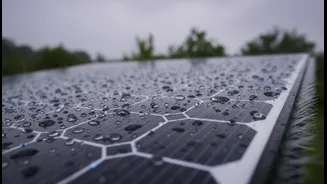
The technology behind this innovation is a device called a triboelectric nanogenerator, or TENG. The concept is based on the triboelectric effect, which is the same phenomenon that causes static electricity. When two different materials make contact and then separate, one can steal electrons from the other, creating an electrical charge difference. In this case, a specialized transparent layer is placed over the solar cell. When a raindrop, which is naturally slightly positively charged, hits this surface and rolls off, it creates a tiny but measurable electric potential. The TENG is designed to capture this kinetic and electrostatic energy and convert it into usable electricity. It’s a way of harvesting mechanical energy from the environment, much like a tiny hydroelectric dam on the surface of the panel.
From Sunlight to Storms
The goal is not to replace traditional solar cells but to augment them. Scientists from institutions like China's Soochow University and Spain's Institute of Materials Science of Seville are working on integrating these TENG layers directly onto solar panels. The design creates a single, all-weather device. On a sunny day, it functions as a normal photovoltaic (PV) panel. During rainfall, the TENG layer springs into action, generating power from the droplets, meaning the panel can produce electricity day or night, as long as it's raining. Some advanced designs use materials like perovskites, which are highly efficient at converting sunlight, protected by a film that also serves as the triboelectric layer, creating a durable, dual-purpose panel.
A Game-Changer for India's Energy Grid
The implications for India are enormous. The monsoon is a defining feature of the subcontinent's climate, but it severely hampers solar generation, with output sometimes dropping by 20% to 60% on the cloudiest days. All-weather solar panels could provide a more consistent and reliable stream of renewable energy year-round. This would reduce the grid's dependence on fossil fuels during the rainy season, enhance energy security, and help stabilize power supply. While the power generated from rain is currently much lower than that from bright sunlight, it adds a baseline level of production during periods that would otherwise yield very little. This could be particularly transformative for remote areas and for critical infrastructure that requires an uninterrupted power supply.
The Hurdles to Widespread Adoption
Despite the promise, this technology is still in its early stages. The primary challenge is efficiency. The amount of electricity generated by TENGs from raindrops is currently quite small, often only enough to power small electronic devices. Researchers are working to improve the power output density. Furthermore, manufacturing these hybrid panels is complex and, at present, costly. Integrating a new layer without compromising the transparency and efficiency of the underlying solar cell is a delicate balancing act. Before these panels can be rolled out on a commercial scale, significant progress is needed to boost their power generation from rain, bring down production costs, and prove their long-term durability in real-world conditions.