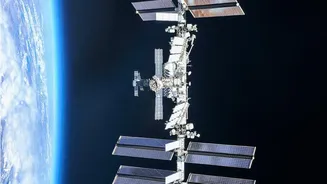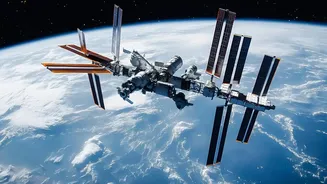

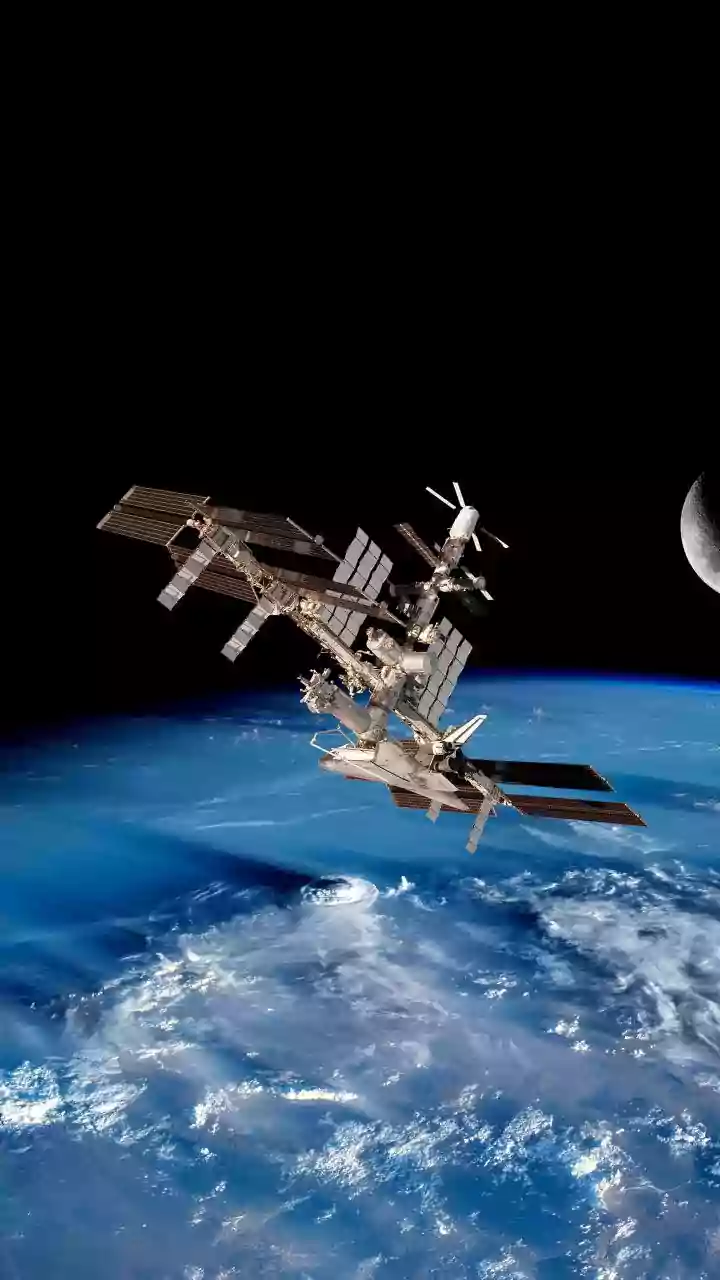
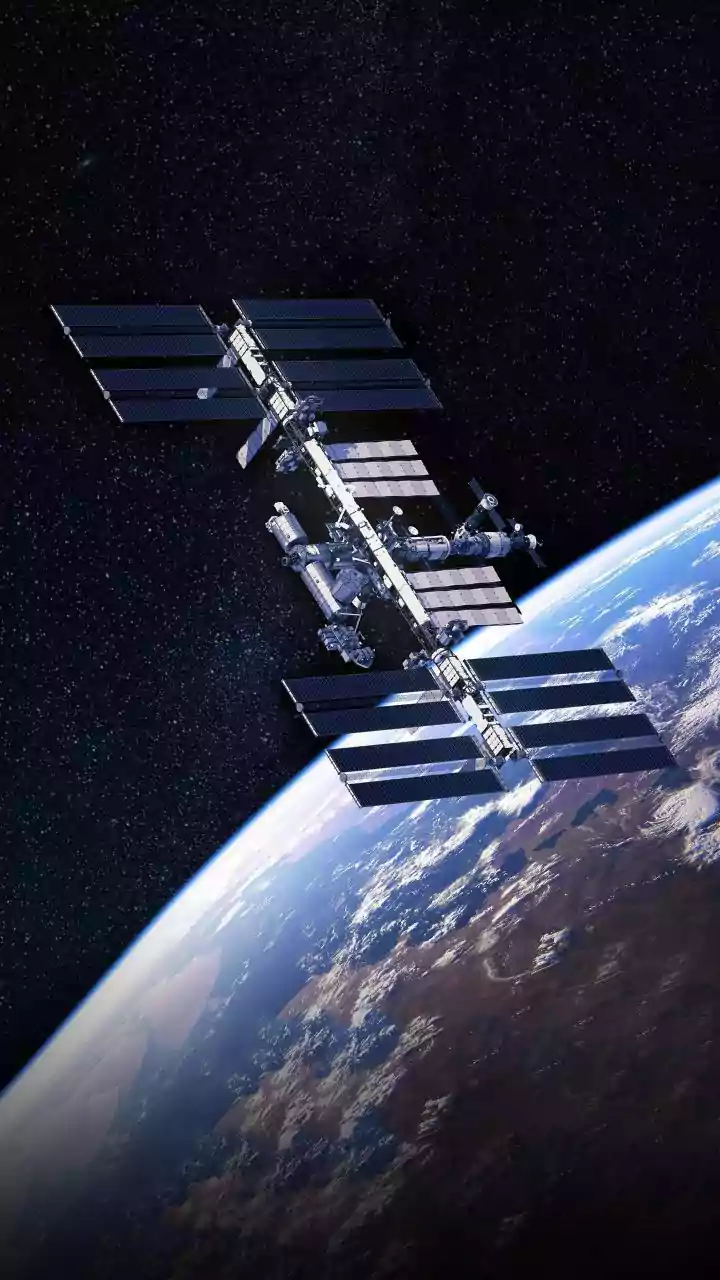

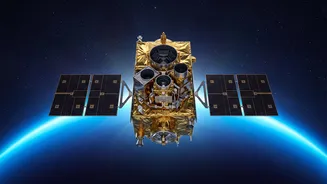

It’s a fair question that stumps plenty of people: a massive object like the International Space Station is constantly being pulled by Earth’s gravity, so why doesn't it just plummet back to the surface? The answer isn't that it's beyond gravity's reach.
The Constant Tug of Gravity
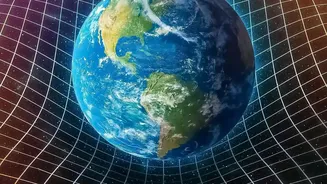
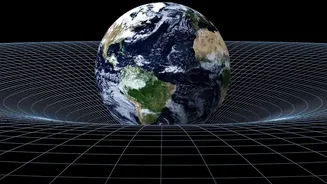
First, let's clear up a major myth. There is no such thing as 'zero gravity' in low-Earth orbit. In fact, at the altitude of the International Space Station (ISS)—about 250 miles up—Earth's gravitational pull is still about 90% as strong as it is on the ground. If you could somehow build a tower that high and drop a rock from the top, it would fall straight down and accelerate just as you'd expect. Gravity is very much present and is relentlessly pulling on the station and everything inside it, every single second. This constant downward force is the first key part of the orbital equation. Without it, any object in orbit would simply fly off in a straight line into the void of space. So, the question isn't why gravity isn't working; it's what other force is working alongside it.
The Secret Ingredient: Sideways Speed
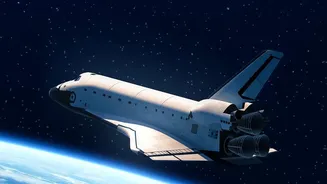
The magic that keeps a space station from falling to Earth is its incredible forward velocity. To stay in orbit, the ISS has to travel at a staggering speed of about 17,500 miles per hour (roughly 5 miles per second). This immense sideways motion is the crucial counter-element to gravity's downward pull. Think of it this way, using a thought experiment from Isaac Newton: if you fire a cannonball from a very tall mountain, it travels some distance before gravity pulls it to the ground. If you fire it with more speed, it travels farther before landing. Now, imagine you could fire it with so much horizontal speed that as it falls, the Earth's surface curves away beneath it at the exact same rate. The cannonball would then be perpetually falling, but it would never actually get any closer to the ground. It would be in orbit. This is precisely what's happening with a space station.
A Perpetual State of Falling
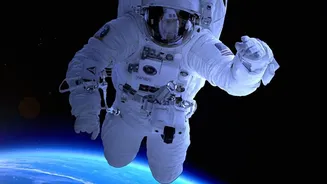
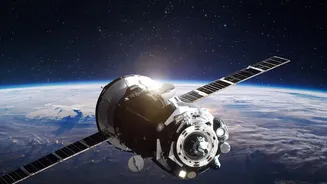
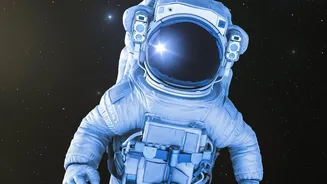
Combining these two ideas—gravity's pull and immense sideways speed—reveals the beautiful truth of orbital mechanics: an orbit is a state of continuous freefall. The space station, the astronauts inside, and every piece of equipment are all constantly falling toward Earth. However, because they are also moving sideways at such a high velocity, they continuously 'miss' the planet. This is also why astronauts experience weightlessness. It's not because there is no gravity, but because they and their surroundings are all falling together at the same rate. It’s a similar feeling to being in an elevator when the cable snaps; for those brief moments of freefall, you would feel weightless. The ISS and its crew are simply in a permanent state of this controlled fall, forever looping around the planet instead of crashing into it.
The Slow Drift and Necessary Boosts
While the balance of gravity and velocity is nearly perfect, it isn't entirely self-sustaining for stations in low-Earth orbit. We often think of space as a perfect vacuum, but hundreds of miles up, there's still a very thin atmosphere. As the ISS plows through these sparse atmospheric particles at 17,500 mph, it experiences a small but constant amount of drag. This atmospheric friction acts like a brake, slowly reducing the station's speed. As the station slows down, its orbit begins to decay, causing it to lose altitude—sometimes by as much as 100 meters per day. If left uncorrected, this orbital decay would eventually cause the station to fall back into the denser parts of the atmosphere and burn up. To counteract this, engineers periodically fire thrusters on the station or a docked spacecraft. This procedure, called a 'reboost', increases the station's speed and pushes it back up to its proper altitude, resetting the delicate balance and ensuring it continues to fall around the Earth, not onto it.