

From a Dry Rock to a Water Reservoir
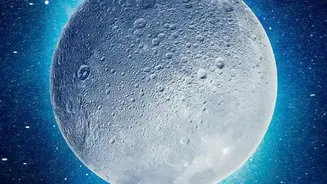
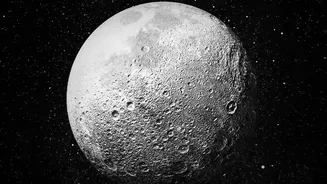
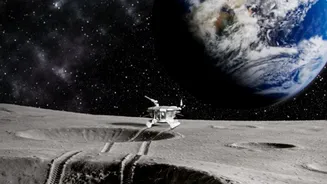
For most of modern history, the Moon was considered a completely dry, desolate world. The Apollo missions returned with rocks that seemed to confirm this, showing no signs of hydration. This perception began to shift dramatically in 2008, thanks in large
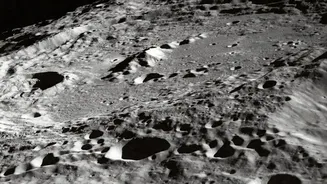
part to India's own Chandrayaan-1 mission. Carrying a NASA instrument called the Moon Mineralogy Mapper, it provided the first definitive evidence of water molecules on the lunar surface. A year later, NASA's Lunar Reconnaissance Orbiter (LRO) mission solidified these findings. Its companion probe, LCROSS, was deliberately crashed into a crater near the south pole, sending a plume of debris into space that was found to contain significant amounts of water ice. These discoveries centered on 'Permanently Shadowed Regions' (PSRs) — deep craters at the poles that haven't seen direct sunlight in billions of years. Their extreme cold acts as a perfect trap for water ice, but also makes them incredibly difficult and dangerous places to explore.
Finding Water in Unexpected Places
The next major breakthrough came from an unusual source: a modified Boeing 747. NASA's Stratospheric Observatory for Infrared Astronomy (SOFIA) is a telescope that flies high in Earth's atmosphere to get a clear view of the cosmos. In 2020, it was pointed at the Moon and made a landmark discovery. Using its powerful spectrometer, which analyses light to determine chemical composition, SOFIA found the unique signature of H2O—actual water—on the sunlit surface of the Moon. Previous instruments could only detect hydrogen, but couldn't distinguish between water (H2O) and its chemical cousin hydroxyl (OH). While the amount of water found was small, roughly equivalent to a small bottle of water in a cubic metre of soil, the discovery was profound. It proved that water wasn't just confined to the ultra-cold polar craters but could be distributed across more of the lunar surface, likely trapped within glass beads or between grains of soil, offering protection from the harsh solar radiation.
India’s Deepening Role in the Water Hunt
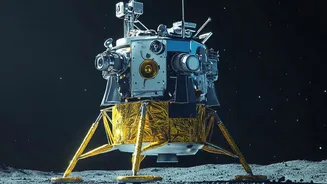
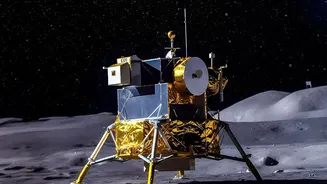
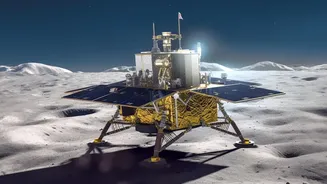
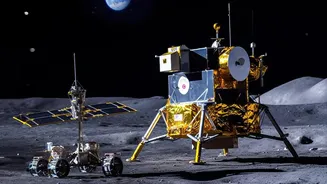
India's contribution to understanding lunar water didn't end with Chandrayaan-1. The orbiter from the Chandrayaan-2 mission, which has been circling the Moon since 2019, has provided powerful new evidence suggesting the presence of more stable water ice buried beneath the surface in those same polar craters. This is a critical piece of the puzzle. While surface ice is useful, subsurface ice is better protected from the vacuum of space and solar wind, making it a more reliable and potentially abundant resource. These findings are directly informing future missions. India's space agency, ISRO, is collaborating with Japan's JAXA on a robotic lunar polar exploration mission called LUPEX. This rover is specifically designed to drill into the lunar surface at the south pole to confirm the quantity and quality of this subsurface ice, moving from orbital detection to ground-truth confirmation.
How to See Buried Treasure
Finding the exact locations of these buried ice deposits is the next great challenge. A recent study published in July 2026 proposed an ingenious new method: using seismic waves. The idea is that frozen soil behaves very differently from dry soil when vibrations pass through it. Ice stiffens the regolith, causing seismic waves—perhaps from small, induced impacts or natural moonquakes—to travel two to three times faster. By setting up seismometers, future missions could effectively create an ultrasound map of the lunar subsurface, pinpointing the richest concentrations of buried ice without having to drill randomly. This technique transforms the search from a guessing game into a targeted hunt, dramatically increasing the chances of finding large, accessible deposits.
The Dawn of a Lunar Economy
The reason this quest for water is so intense is that it unlocks a concept called 'in-situ resource utilisation' (ISRU), a fancy term for living off the land. Lunar water is far more than just a drink for astronauts. Through a process called electrolysis, it can be split into its component parts: oxygen and hydrogen. The oxygen can be used for breathable air in a lunar habitat, while the hydrogen can be combined with oxygen to create powerful rocket fuel. This changes everything. A lunar base with access to water ice could become a self-sustaining outpost and, crucially, a refueling station for deep space missions. Instead of having to launch every drop of fuel from Earth's heavy gravity, missions heading to Mars and beyond could top up their tanks at the Moon, dramatically reducing cost and complexity.