






The Growing Danger in Our Skies
Low Earth Orbit (LEO) is home to thousands of active satellites essential for communication, navigation, and science. But it's also cluttered with an ever-growing population of space debris. This includes everything from spent rocket stages to millions
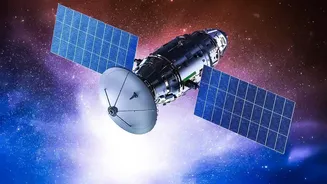
of tiny fragments. Among the most dangerous are whole, non-functional satellites. These massive objects, sometimes tumbling unpredictably, travel at speeds over 28,000 kilometres per hour. A collision with one could be catastrophic, creating thousands more pieces of debris and threatening operational spacecraft in a chain reaction known as the Kessler syndrome. The challenge is clear: we need a safe and reliable way to remove these ticking time bombs from orbit.
The Challenge of a Contactless Capture
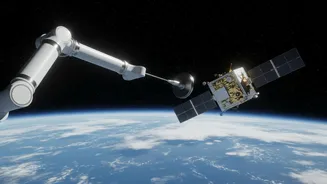
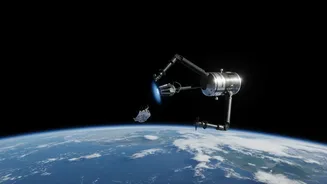
Capturing an unresponsive, tumbling satellite is an immense engineering challenge. These objects were not designed to be grabbed or serviced. Trying to capture one with a robotic arm, net, or harpoon carries significant risk; a clumsy approach could damage the target, create even more debris, or destabilize the capture vehicle itself. An ideal solution would be one that doesn't require physical contact until the moment of capture, and can gently stabilize the target before latching on. This is precisely where the physics of magnetism provides a revolutionary approach.
Introducing the Eddy Current Brake
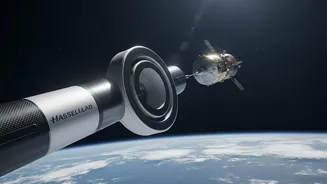
The secret to this magnetic handshake lies in a principle called eddy currents. You don't need the target satellite to be magnetic itself. Most satellites are built with conductive, non-magnetic materials like aluminum alloys. A 'chaser' satellite can approach a piece of debris and project a strong, changing magnetic field from an electromagnet. As this magnetic field passes through the conductive surface of the target satellite, it induces small, swirling electrical currents within the metal—these are eddy currents. According to the laws of physics, these eddy currents generate their own magnetic field that opposes the one from the chaser satellite. This opposition creates a gentle braking force, slowing the target's spin without ever touching it.
From Gentle Braking to Secure Latch
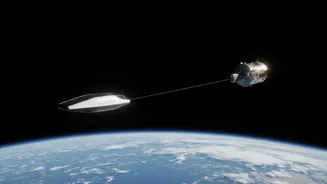
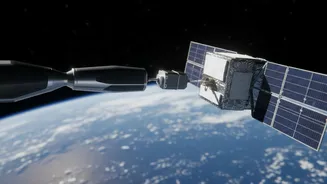
The process is a carefully choreographed dance. A servicing vehicle, or 'chaser', approaches the unresponsive satellite. It first uses its magnetic probe to induce those eddy currents, gradually and safely slowing any tumbling motion. This 'de-tumbling' phase is critical for ensuring a safe and predictable capture. Once the target is stabilized, the chaser can move in closer. At this point, powerful electromagnets on the chaser create a strong attractive force, pulling the two spacecraft together for a 'soft docking' that minimizes impact. After the initial magnetic latch, mechanical locks can engage to secure the connection, allowing the chaser to then tow the defunct satellite to a safe disposal orbit where it can burn up in the atmosphere.
The Future of On-Orbit Servicing
This technology is moving from theory to reality. Space agencies and private companies like Astroscale are actively developing and testing magnetic docking systems. Some concepts envision future satellites being built with a standardized magnetic 'docking plate' to make them easier to capture at the end of their life. The applications go beyond just debris removal. Magnetic systems could enable on-orbit servicing missions where satellites are refuelled, repaired, or upgraded, dramatically extending the life of valuable space assets and reducing the cost of space operations. Projects like the European Space Agency's Clearspace-1 mission, though initially using a different capture method, are paving the way for a future where active debris removal is routine. This will create a new commercial industry dedicated to keeping space sustainable for generations to come.