




A New Polygon in the Gas Giant's Sky
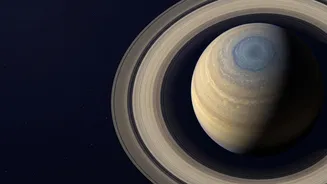
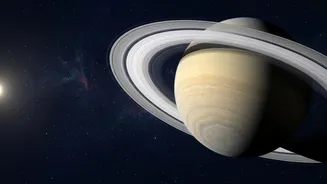
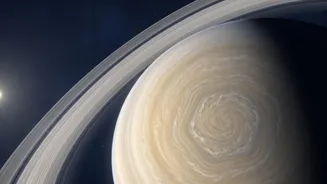
For decades, Saturn's most famous atmospheric feature, besides its bands of clouds, has been the strange, six-sided hexagon at its north pole. It’s a remarkably stable jet stream pattern that has puzzled scientists since the Voyager flybys in the 1980s.
Now, it seems the hexagon is no longer one of a kind. Astronomers have identified a new, ten-sided atmospheric wave—a decagon—circling the planet’s south pole. Announced in early September 2026 and published in the journal Science Advances, the discovery was made using data from NASA's Hubble Space Telescope. Unlike the long-observed hexagon, this southern feature appears to be a recent development, giving scientists a rare chance to see a massive planetary weather pattern take shape in real time.
How a Ghostly Shape Came Into View
The discovery was a masterclass in modern astronomy, combining the power of professional observatories with the keen eyes of amateur sky-watchers. The lead author of the study, Agustín Sánchez-Lavega from the University of the Basque Country, first noticed hints of a strange undulation in images submitted by amateur astronomers in 2024. Due to Saturn’s axial tilt, its south pole was hidden from Earth's view for over a decade, from roughly 2012 to 2023. As the pole gradually tilted back into view, these ground-based observations provided the first clues. The team then turned to the Hubble Space Telescope's Outer Planet Atmospheres Legacy (OPAL) program, which regularly monitors our solar system's gas giants. The crystal-clear Hubble images, free from the blurring of Earth’s atmosphere, confirmed the feature’s existence, tracing its emergence back to at least 2023. Intriguingly, NASA's Cassini spacecraft, which orbited Saturn from 2004 to 2017, saw no sign of a persistent decagon, confirming this is a new phenomenon.
The Tale of Two Poles
While the decagon provides a southern counterpart to the northern hexagon, the two are far from identical twins. The most obvious difference is the number of sides—ten versus six. In the physics of planetary atmospheres, the number of sides in a polygonal wave is related to the speed and width of the jet stream that contains it. This suggests the conditions at Saturn's two poles are significantly different. Furthermore, the northern hexagon has been a stable, almost stationary feature for over 40 years. The southern decagon, however, is a newer, evolving structure that appears to be strengthening. It's also located at a slightly less polar latitude than the hexagon. Scientists believe these differences will provide a powerful natural laboratory for understanding what drives the formation of these incredible geometric patterns.
More Than Just a Pretty Pattern
So, what creates these shapes? The leading theory for both the hexagon and the decagon involves instabilities in powerful jet streams—rivers of wind moving at hundreds of kilometers per hour. Small disturbances in these jets can be forced into a stable, repeating wave pattern, much like how a vibrating string produces a steady musical note. Laboratory experiments with spinning tanks of fluid have been able to create similar polygonal shapes, suggesting the phenomenon is rooted in fundamental fluid dynamics. The Saturn decagon is not just a surface feature in the clouds; observations show it extends deep into the atmosphere, making it a vertically stacked structure. This depth gives it stability and suggests it's a major component of the planet's atmospheric engine. One theory for its recent formation points to a nearby vortex that may have provided the initial trigger.