




What is Digital Provenance?
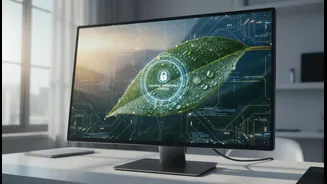
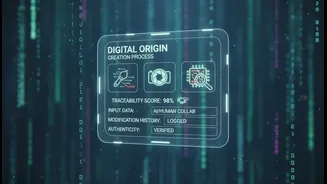
Think of digital provenance as a 'Made In' label and nutritional guide for online content. At its core, it's a verifiable record that traces a digital file—like an image, video, or document—from its creation through every subsequent edit. This creates
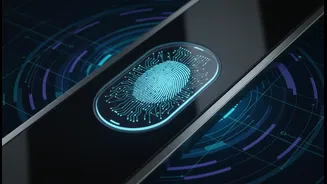
a tamper-evident audit trail, answering key questions: Who created this? When was it made? And has it been altered? Major tech and media companies, including Adobe, Microsoft, Google, and the BBC, have collaborated on this, leading to the establishment of the Coalition for Content Provenance and Authenticity (C2PA). This group has developed an open standard, often called Content Credentials, that functions like a secure digital watermark or fingerprint embedded directly into a file.
How The Technology Works
Instead of trying to detect fakes after they've spread, C2PA focuses on certifying authentic content at its source. It uses cryptographic technology to create a signed manifest—a secure log of the content's history. When a photo is taken with a C2PA-enabled camera or an image is edited in compliant software, a secure record is generated and attached to the file. This record is cryptographically signed, meaning any change to the file, like cropping or colour correction, is added to its log. If someone tries to tamper with the content or the log, the cryptographic signature breaks, immediately revealing the manipulation. This allows anyone viewing the content to see a verifiable history of its origins and modifications, providing a new layer of transparency.
The Unseen Limitations
While powerful, these tools have significant limitations. Firstly, their effectiveness depends on widespread, voluntary adoption. Content created without C2PA-enabled tools will simply lack credentials, which says nothing definitive about its authenticity. Secondly, the metadata can be stripped, either accidentally when a file is saved by non-compliant software or deliberately by malicious actors. Most importantly, C2PA verifies the 'who' and 'how' of content creation, not the 'what' or 'why'. A valid Content Credential can prove a photo was taken by a specific camera at a specific time, but it can't prove the photo isn't staged to be misleading. A deepfake video of a politician could, in theory, carry a valid credential stating it was created with an AI tool, leaving the viewer to interpret its meaning. The technology provides transparency about origin, not a final judgment on truthfulness.
Why Human Verification Endures
This is where traditional source checking remains irreplaceable. Journalistic skepticism, contextual analysis, and corroboration are skills that technology cannot automate. A digital provenance tool can verify that a video file originated from a trusted news organization. But a journalist must still ask critical questions: Does the content in the video align with other known facts? Is the framing of the shot misleading? Is there a broader context that viewers are not seeing? These human-led inquiries dig into the substance and intent of the content, areas where technology is currently blind. Relying solely on a digital stamp of approval without this critical oversight would be a grave mistake. It's like having a high-tech security system that logs everyone who enters a building, but still needing a security guard to determine if their intentions are benign or hostile.
A Powerful Partnership for Trust
The most effective path forward is not a choice between technology and human verification, but a fusion of the two. Digital provenance tools provide a powerful first line of defense, filtering out crudely manipulated content and providing a baseline of origin data. They empower journalists, researchers, and the public by giving them more information to work with. This allows human experts to focus their energy where it's needed most: on interpreting the content itself, understanding its context, and vetting the substance of the claims being made. The technology authenticates the file, while the human authenticates the facts. One is a technical process of validation, the other is an intellectual process of verification. Both are essential in the modern information ecosystem to rebuild and maintain trust.