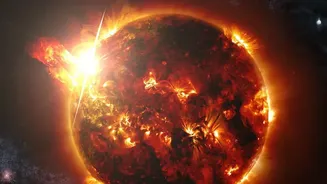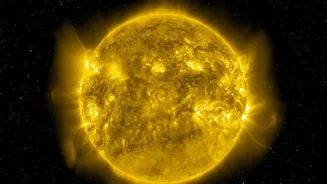







It’s a cosmic riddle that defies everyday logic. While the Sun's surface simmers at around 5,500 degrees Celsius, its outer atmosphere, the corona, sizzles at a staggering 1 to 2 million degrees. How can it get hotter as you move away from the heat source?
A Paradox at the Heart of Our Solar System
Imagine standing by a campfire and feeling the air get hotter the farther you walk away from the flames. It makes no sense, yet this is precisely what happens with our Sun. This phenomenon is known as the coronal heating problem, and it has puzzled astrophysicists for decades. The Sun's visible surface, called the photosphere, is the source of its light and heat, burning at a temperature that, while incredibly hot, is dwarfed by its own atmosphere. The corona, a tenuous halo of plasma visible during a total solar eclipse, is hundreds of times hotter. According to the laws of thermodynamics, heat shouldn't flow from a cooler object to a hotter one. This mystery implies that some other process must be pumping a colossal amount of energy into the corona, and scientists have been on the hunt to figure out exactly how.
Theory 1: A Storm of Tiny Explosions
One of the leading theories centres on the Sun's powerful and complex magnetic fields. The idea, proposed by astrophysicist Eugene Parker in 1988, is that the corona is heated by a relentless storm of tiny, impulsive energy releases called 'nanoflares'. Unlike the giant, spectacular solar flares that we can observe from Earth, nanoflares are billions of times weaker. The theory suggests that the constant churning and motion on the Sun's surface twists and braids the magnetic field lines that extend up into the corona. This process builds up tension, which is then suddenly released in countless small but powerful magnetic reconnection events. While a single nanoflare wouldn't do much, the combined, continuous effect of trillions of them going off across the Sun could be enough to maintain the corona's extreme temperatures. The main challenge is that nanoflares are too small and frequent to be observed directly with current instruments.
Theory 2: Cracking a Magnetic Whip
Another major contender is the wave heating theory. This concept proposes that energy is transported from the Sun's surface into the corona by waves travelling along magnetic field lines. The Sun's turbulent surface, roiling with plasma, acts like a giant bell, sending different types of waves rippling up into the atmosphere. One particular type, known as Alfvén waves, are vibrations that travel along magnetic field lines, much like a wave travelling down a plucked guitar string. These waves can carry huge amounts of energy from the dense lower atmosphere up into the far less dense corona. As they travel upwards into the thinner coronal plasma, the waves are thought to 'break' or dissipate, depositing their energy as heat. Recent simulations have shown that this process, especially a form called Alfvén wave turbulence, could account for a significant portion of the heating required.
Hunting for Answers by 'Touching the Sun'
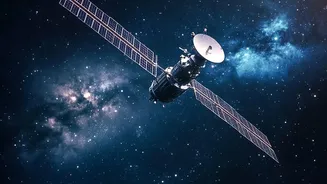
For decades, these theories remained difficult to prove. But now, humanity is getting closer to the source than ever before. NASA's Parker Solar Probe, launched in 2018, is on a historic mission to fly directly through the corona. In 2021, the spacecraft officially 'touched the Sun' by flying through the corona's outer boundary, known as the Alfvén critical surface, allowing it to sample the plasma and magnetic fields directly. Data from the probe has provided crucial insights. It has observed wavelike phenomena and 'switchbacks' — sudden, S-shaped reversals in the magnetic field that release energy as they travel. While early data has ruled out some specific ideas about where these switchbacks form, it has confirmed they are a common feature and could play a role in heating both the corona and the solar wind.