




First, Let's Define Day and Year
Before we travel to Venus, let's get our basics straight right here on Earth. A ‘day’ is the time it takes for a planet to complete one full rotation on its axis. This is what gives us our cycle of daylight and darkness. A ‘year’ is the time it takes for a planet to complete one full orbit
around its star—in our case, the Sun. On Earth, this is a familiar rhythm: a 24-hour rotation for a day and a 365.25-day orbit for a year. This relationship feels intuitive and normal. Our days are short, and our years are long. This simple logic, however, gets completely turned on its head when we look at Venus.
Welcome to Venus, Earth's 'Twisted Sister'
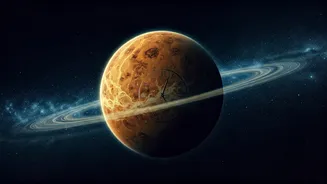
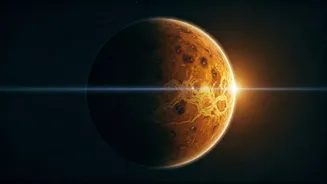
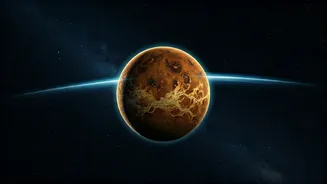
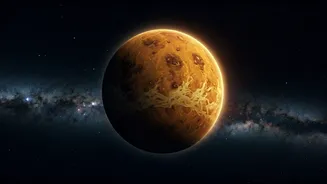
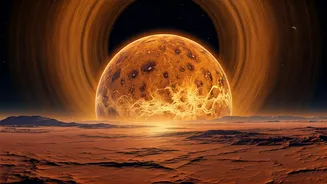
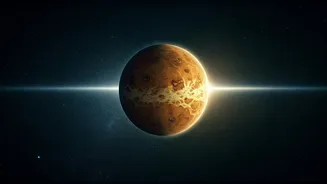
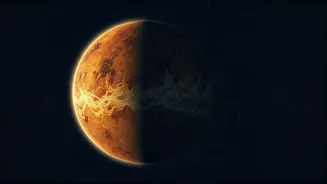
Venus is often called Earth’s “sister planet” due to its similar size and mass. But if it's our sister, it's the one with a flair for the dramatic and a love for extremes. Its surface is a scorching hellscape with temperatures hot enough to melt lead, and its atmosphere is thick with crushing pressure and sulphuric acid clouds. While we knew about its hostile environment for decades, the truly mind-bending discovery was how it moves. Its sense of time is unlike anything else in the solar system, making our own planet's neat and tidy schedule seem wonderfully straightforward.
A Day That's Longer Than a Year
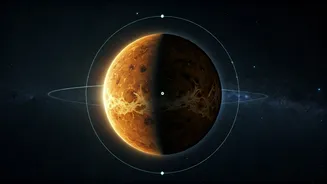
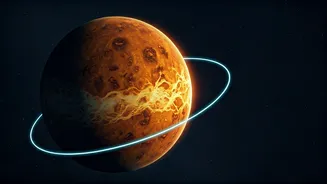
Here’s the core of the paradox. A year on Venus—the time it takes to go around the Sun once—is about 225 Earth days. Now, for the day. A sidereal day on Venus—the time it takes for the planet to spin 360 degrees on its axis—is approximately 243 Earth days. You read that correctly. It takes longer for Venus to complete a single spin than it does for it to complete an entire journey around the Sun. Imagine celebrating your New Year’s party before the first day of the year has even technically finished. That's the reality on Venus. This is because Venus has an incredibly slow rotation, the slowest of any planet in our solar system.
The Strange Backward Spin
To make things even stranger, Venus spins backward. While Earth and most other planets rotate counter-clockwise on their axes, Venus spins clockwise. This is known as retrograde rotation. If you could stand on the surface of Venus (and somehow survive), you would see the Sun rise in the west and set in the east. This backward spin has a fascinating effect on the length of its 'solar day'—the time from one sunrise to the next. Because the planet is rotating backward as it orbits the Sun, the time between sunrises is actually much shorter than its rotational period.
So, How Long Is a 'Real' Day?
This is where it gets a little more complex. While the sidereal day (one full spin) is 243 Earth days, the solar day (sunrise to sunrise) is about 117 Earth days. It’s still incredibly long, but significantly shorter than its year. Think of it like walking backward on a moving walkway. Even though you are taking steps backward (retrograde rotation), the moving walkway (the orbit) is carrying you forward, changing your position relative to where you started. On Venus, this combination of a slow backward spin and its forward orbit results in two sunrises and two sunsets per Venusian year, even though less than one full rotation has occurred. So, while a Venusian sidereal day is longer than a Venusian year, a Venusian solar day is shorter.
Why Is Venus So Weird?
Scientists don't have a definitive answer, but there are a few leading theories. One popular hypothesis suggests that Venus was struck by a massive asteroid or protoplanet billions of years ago. Such a cataclysmic impact could have been powerful enough to not only halt its original rotation but actually reverse it. Another theory points to its incredibly thick and heavy atmosphere. Over billions of years, powerful atmospheric tides, driven by the Sun's heat, could have acted like a brake, slowing the planet’s rotation to its current leisurely, backward pace. Whatever the cause, Venus stands as a stunning reminder that the universe doesn't always follow the rules we're used to.