



The Cosmic Speed Limit
Everything in the universe, including light, has a speed limit. Light travels incredibly fast—about 300,000 kilometres per second. That’s fast enough to circle the Earth more than seven times in a single second. On a human scale, it seems instantaneous.
But in the vast emptiness of space, those distances are so immense that even light needs time to travel. This is where the concept of a 'light-year' comes from. It isn't a measure of time, but of distance. A light-year is the distance light travels in one year, which is a staggering 9.46 trillion kilometres. So, when we say a star is 100 light-years away, we mean the light we see from it tonight began its journey 100 years ago. You are, quite literally, looking at history.
A Quick Tour of the Past
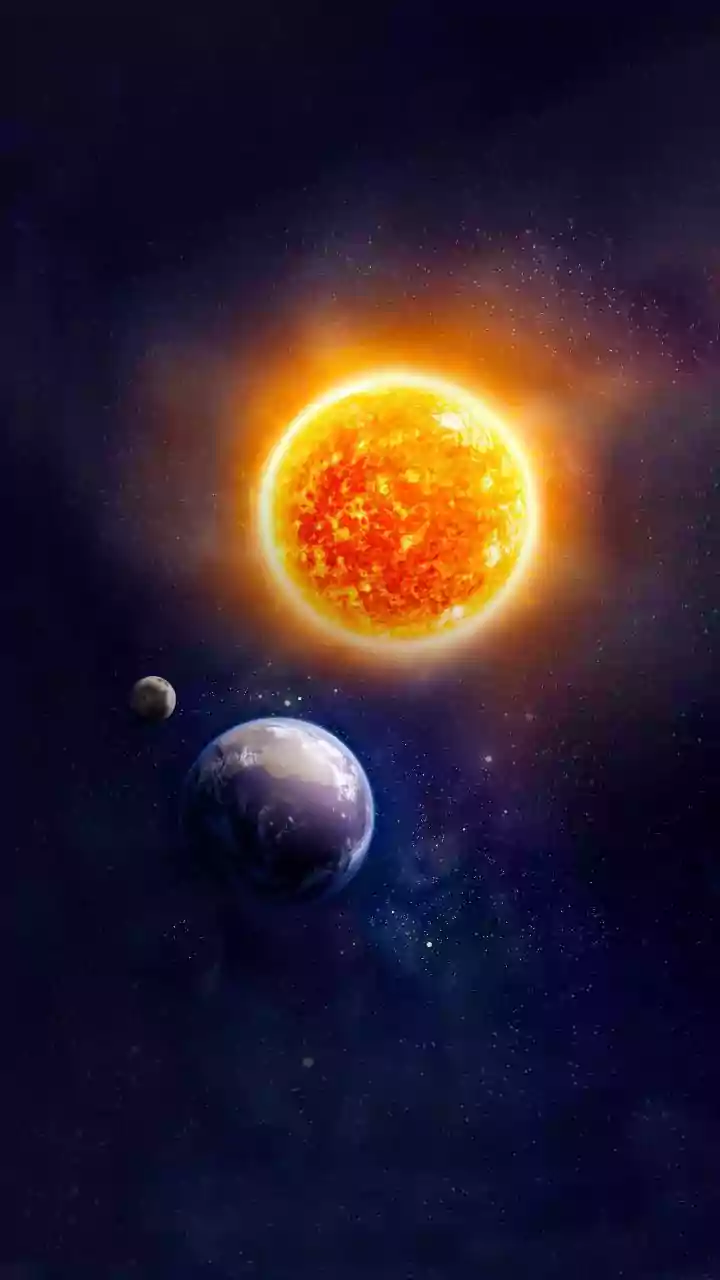
Let’s take a tour of our celestial neighbourhood. The closest star system to us is Alpha Centauri, about 4.3 light-years away. The light you see from it tonight left when you were perhaps just starting primary school. It’s a relatively recent postcard from space. Now, look for Polaris, the North Star. It's a familiar beacon for travellers, but it’s much farther, around 433 light-years away. The light from Polaris that reaches your eyes tonight started its journey around the time the Taj Mahal was being completed in Agra. The world was a vastly different place. Empires have risen and fallen in the time it took that single photon to travel from its star to your retina.
Seeing Ghosts in the Sky
This cosmic time-delay has a fascinating and slightly eerie consequence: we might be looking at stars that are no longer there. A star’s life is long, but not infinite. Massive stars end their lives in spectacular explosions called supernovae. Consider Betelgeuse, the bright reddish star in the Orion constellation. It's about 640 light-years away. Betelgeuse is a red supergiant nearing the end of its life. Astronomers believe it could go supernova anytime in the next 100,000 years. The key word is *could*. It might have already exploded 200 years ago, and we wouldn't know. We would continue to see it shining brightly in our sky for another 440 years, completely oblivious to its demise, until the light from its final, cataclysmic explosion finally reaches us.
Even Deeper Time Travel
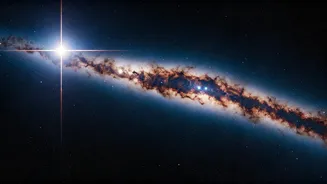
The effect is even more profound when we look beyond individual stars. On a very clear, dark night, far from city lights, you might be able to spot a faint, fuzzy patch in the sky. That is the Andromeda Galaxy, our closest major galactic neighbour. It is a collection of a trillion stars, and it is 2.5 million light-years away. The light from Andromeda that you see tonight began its journey when our earliest human ancestors, of the genus *Homo*, were first walking the Earth. It has been travelling through space for all of human evolution. Every discovery, every civilization, every moment of human history has played out while that ancient light was still on its way to us.