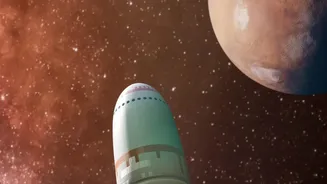






The dream of reaching Mars is a powerful one, but it raises a critical question: who, or what, should go? The choice between sending human astronauts or robotic explorers involves a complex trade-off between staggering costs, immense risks, and the ultimate
scientific prize.
The Staggering Price Tag
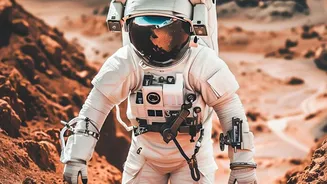
The most immediate and stark difference between human and robotic missions to Mars is the cost. Robotic missions, while not cheap, are orders of magnitude more affordable. For example, NASA's highly successful Perseverance rover mission cost around $2.7 billion. In contrast, estimates for a single crewed mission to Mars are vast, ranging from $100 billion to as high as $600 billion or even more over the life of the program. This enormous gap comes down to one fundamental factor: keeping humans alive. Astronauts require life support systems, food, water, and oxygen for a mission that could last up to three years. All of this adds immense weight, which in turn requires more powerful rockets and significantly more fuel. Most importantly, a human crew needs a return ticket—a complex, heavy, and expensive vehicle capable of launching from Mars to bring them safely home, a requirement robotic explorers don't have.
A Universe of Competing Risks
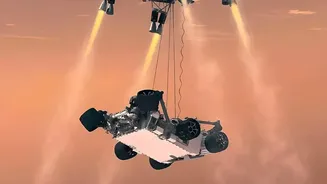
Beyond the financial burden, the risks involved are profoundly different. For a robotic mission, the primary risk is equipment failure. A malfunction during launch, landing, or operations could end a multi-billion dollar mission in an instant. However, there is no risk to human life. For astronauts, the dangers are constant and severe. The long journey through deep space exposes them to high levels of cosmic radiation, which poses significant long-term health risks. Prolonged time in microgravity can cause muscle atrophy and bone density loss. Then there are the immense psychological pressures of confinement and isolation, with communication delays to Earth of up to 20 minutes each way making real-time conversation impossible. And, of course, any critical failure of life support or a landing system would be catastrophic for the crew.
Scientific Bang for Your Buck
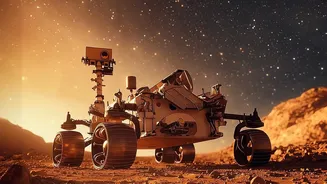
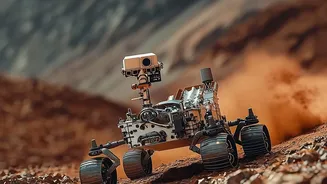
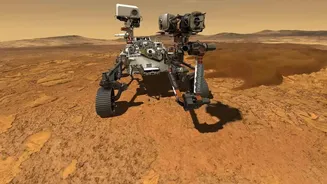
This is where the debate becomes more nuanced. Robots are exceptional at what they're designed to do. They can operate 24/7 in harsh conditions, performing precise measurements and collecting samples. Missions like Perseverance and Curiosity have fundamentally changed our understanding of the Red Planet. However, they are slow and limited. The Curiosity rover moves at a top speed of just 0.14 kilometres per hour. An astronaut, by comparison, could cover far more ground, make intuitive leaps, and react to unexpected discoveries instantly. Humans are adaptable problem-solvers. An astronaut could investigate a curious rock formation, pivot a research plan on the spot, or perform complex repairs—tasks that are difficult or impossible for a robot operating on a 20-minute time delay. Studies have shown that human-led missions, like the Apollo program, can generate a far greater volume of samples and scientific data than robotic ones.
The Intangible Human Factor
Ultimately, the argument for sending humans isn't just about efficiency. Robotic missions inspire scientists and enthusiasts, but landing humans on another planet is a civilization-defining moment. The Apollo Moon landings galvanized generations, not just because of the science gathered, but because it was a profound human achievement. This inspirational value is a powerful driver, encouraging education in science and engineering and uniting people in a common, hopeful goal. Proponents argue that space exploration is not just about collecting data; it's about pushing the boundaries of human experience. While robots are our invaluable scouts, paving the way and gathering crucial information, many believe they cannot replace the innate human drive to explore and see with our own eyes. The future of Mars exploration will likely depend on a partnership, with robots performing high-risk scouting and preparatory work before humans arrive to make the next great leap.