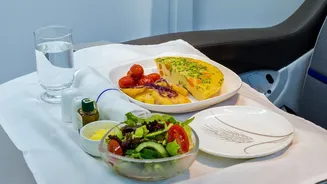






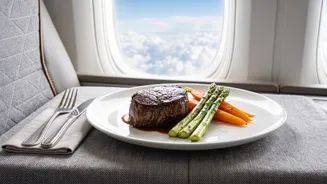

Ever notice how that in-flight glass of tomato juice tastes surprisingly delicious, while the dessert falls flat? It’s not your imagination. The unique environment inside an airplane cabin wages a subtle war on your senses, changing how you taste.
The Sound of Flavour
The
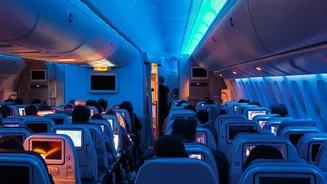
constant drone of an airplane engine, humming along at about 85 decibels, is more than just background noise; it's a flavour modulator. Research, including a notable study from Cornell University, has found that this level of ambient sound directly interferes with our ability to taste. Specifically, it suppresses our perception of sweetness. This might explain why that complimentary biscuit or cake can seem bland and uninspired at 35,000 feet. The theory is that our senses are interconnected, and the loud noise may distract the brain or even physically interfere with the nerves responsible for relaying taste information. This phenomenon of our senses influencing each other is known as cross-modal perception.
The Rise of Savoury
While sweetness takes a hit, another taste profile gets an unexpected boost: umami. Umami is the fifth basic taste, often described as savoury, and is abundant in foods like tomatoes, mushrooms, cured meats, and parmesan cheese. The same studies that showed noise dulling sweetness found that it actually enhances our perception of umami. This is believed to be a key reason why so many passengers suddenly develop a craving for tomato juice or a Bloody Mary in the air, drinks they might rarely order on the ground. Airlines have taken notice, with some, like Lufthansa, reporting that they serve thousands of gallons of tomato juice annually.
It’s Not Just the Noise
The engine roar is a major culprit, but it’s working in tandem with two other factors: low humidity and low cabin pressure. At cruising altitude, the humidity in a plane cabin can drop to below 12-20%, which is drier than most deserts. This aridity dries out the mucous membranes in your nose, and since around 80% of what we perceive as 'flavour' actually comes from our sense of smell, this is a major blow to your palate. Furthermore, the cabin is pressurised to an equivalent of 6,000 to 8,000 feet, not sea level. This lower pressure can slightly reduce blood oxygen levels and cause nasal passages to swell, mimicking the effects of a mild cold and further dulling your senses. This combination significantly impairs your ability to perceive both salty and sweet tastes, by up to 30% according to some studies.
How Airlines Adapt Their Menus
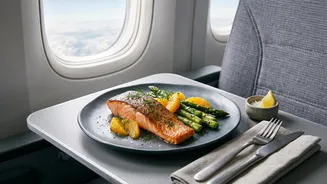
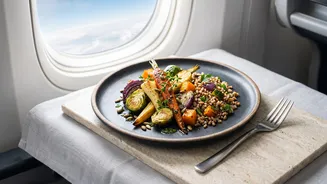
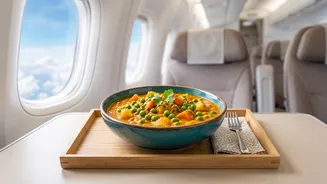
Airline caterers and chefs are well aware of this triple-threat of noise, dryness, and pressure. They can't change the cabin environment, so they change the food. To counteract the sensory dulling, in-flight meals are often prepared with more intense seasoning than their on-the-ground counterparts. Chefs strategically lean into flavours that hold up well under these conditions. This means a focus on umami-rich ingredients like tomato sauces, soy glazes, mushrooms, and aged cheeses. They also use more spices and acidic ingredients like citrus and vinegar, which our palates can still perceive relatively well at altitude. Recipes are often tested in pressurised simulators to see how they will taste in the air before being approved for service.