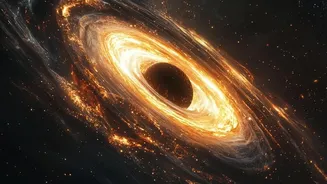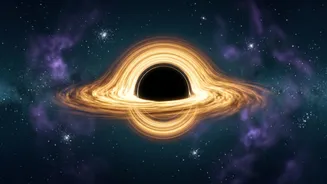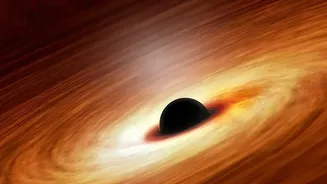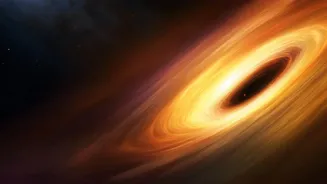


The universe’s most mysterious objects just got more complicated. While we often picture black holes as massive monsters, new research suggests there might be a whole different class of smaller, more elusive black holes lurking in the cosmos.
The Black Hole Family We Knew
Until recently,
astronomers largely sorted black holes into two main categories. First, there are the stellar-mass black holes, typically weighing between five and a few dozen times the mass of our Sun. These form when a single, massive star runs out of fuel and its core collapses under its own immense gravity. Millions of these are thought to be scattered throughout galaxies like our own Milky Way. On the other end of the spectrum are the supermassive black holes, true behemoths that are millions or even billions of times more massive than the Sun. These giants reside at the centers of most large galaxies, including our own, acting as gravitational anchors. For a long time, there seemed to be a 'mass gap' between the heaviest neutron stars (the dense remnants of smaller star deaths) and the lightest black holes.
A New Wrinkle in the Cosmos
The headline-making possibility is that a third, distinct category exists: primordial black holes (PBHs). Unlike their stellar cousins, these smaller black holes are not remnants of dead stars. The theory suggests they formed in the very first moments after the Big Bang. In that chaotic, early environment, tiny, ultra-dense pockets of energy and matter could have collapsed directly into black holes. These objects could be much, much smaller than any stellar-mass black hole, with some theories proposing PBHs with the mass of a planet or even a moon. A primordial black hole with the mass of Earth, for instance, would be only about the size of a small coin. Finding them challenges both our detection methods and our theories about how the universe evolved.
The Hunt for Cosmic Ghosts
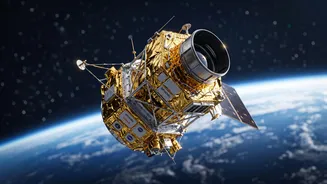
Detecting these smaller, primordial black holes is incredibly difficult. They don't shine, and their gravitational pull is minuscule compared to their larger relatives. However, scientists are using clever techniques. One promising method is gravitational microlensing. When a PBH passes in front of a distant star, its gravity can briefly magnify the star's light in a way that astronomers can detect. Recent analyses of data from telescopes have identified microlensing events that could potentially be explained by primordial black holes. Another avenue is through gravitational waves. While observatories like LIGO are famous for detecting the mergers of large black holes, some researchers theorize that the 'ringing' after a merger or even the theoretical splitting of a tiny black hole could produce faint signals that hint at these smaller objects.
Why This Possibility Matters
Confirming the existence of a separate class of primordial black holes would be more than just an astronomical curiosity; it would be revolutionary. For one, PBHs are a compelling candidate for dark matter. This mysterious, invisible substance makes up about 85% of the matter in the universe, but we don't know what it is. Since PBHs don't require new, undiscovered particles to exist, they are an elegant solution to one of physics' biggest problems. Furthermore, studying them would give us a direct window into the conditions of the universe fractions of a second after the Big Bang—a period of cosmic history that is otherwise completely inaccessible to us. They would be, in effect, fossils from the birth of the cosmos itself.