


The Ultimate Safety Net
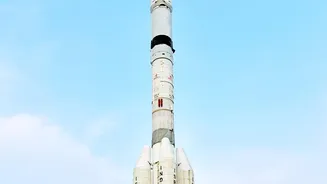
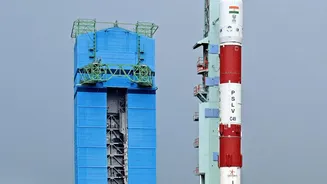
Imagine a scenario just moments after liftoff. Alarms blare as the powerful LVM3 rocket, carrying three Indian astronauts, experiences a critical failure. In this split-second emergency, there is no room for error. This is where the Gaganyaan Crew Escape
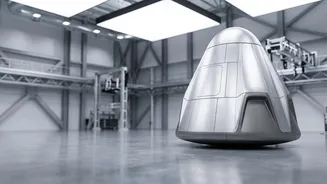
System (CES) comes into play. Think of it as the most advanced and powerful ejection seat ever built, not for a single pilot, but for an entire space capsule. The CES is an emergency measure designed to rapidly pull the crew module and its occupants to a safe distance from the launch vehicle if something goes wrong. Its sole function is to save the crew, making it one of the most crucial technologies being perfected for India's historic human spaceflight program.
Simulating Every Possible Disaster
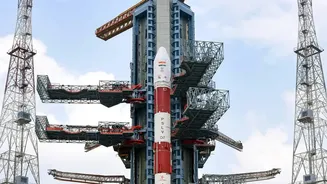
To ensure the CES works flawlessly when needed, the Indian Space Research Organisation (ISRO) must test it against every conceivable failure. These aren't just computer simulations; they are full-scale, real-world tests designed to push the system to its absolute limits. The two primary abort scenarios are a 'Pad Abort' and an 'In-flight Abort'. A Pad Abort Test simulates an emergency on the launch pad itself, before the rocket has even lifted off. In this situation, the CES must have enough power to jettison the crew module high and far enough away from a potential explosion on the ground. An In-flight Abort is even more complex, designed to trigger during the rocket's ascent. For the Test Vehicle Abort Mission-1 (TV-D1), this was simulated at an altitude of around 17 km and a speed of Mach 1.2, or 1.2 times the speed of sound. These tests are meant to validate the system's ability to react, separate, and bring the crew module back to a safe splashdown.
The Anatomy of a High-Speed Escape
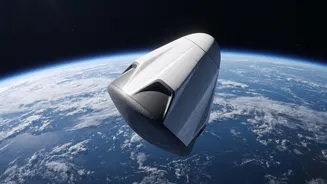
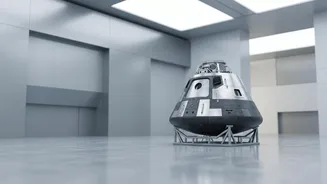
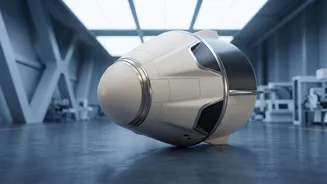
The Crew Escape System is not a single component but a sophisticated sequence of events. It is essentially a set of powerful, quick-acting solid rocket motors attached to the top of the crew module. When an abort is triggered, these motors fire with immense force, pulling the 12.6-tonne crew module away from the main rocket. During the Pad Abort Test in 2018, the system accelerated the module to an altitude of 2.7 km in mere seconds. Once at a safe distance, the escape system jettisons itself, and a complex parachute sequence begins. A series of drogue and main parachutes deploy to slow the module's descent, ensuring a gentle splashdown in the ocean, where recovery teams can retrieve the astronauts. The entire sequence, from abort trigger to splashdown, can be over in just a few minutes.
A Gauntlet of Rigorous Tests
Perfecting this system has involved years of relentless work and a gauntlet of tests. As of mid-2026, ISRO has successfully completed multiple critical milestones. The Pad Abort Test was a major success, demonstrating the safe recovery of the module from a ground-level emergency. The TV-D1 mission in late 2023 successfully demonstrated an in-flight abort, validating the system's performance at high speed and altitude. Beyond these major flight tests, ground teams have been qualifying every component. Recent tests in July 2026 successfully validated the main parachutes and the Crew Module Up-righting System (CMUS), which uses gas inflation to ensure the capsule floats upright after splashing down in the sea. These incremental but vital tests build the confidence needed for the first uncrewed Gaganyaan-1 (G1) mission, currently targeted for the latter half of 2026.