








The Empire's Second City
The story begins with Kolkata, then Calcutta, being the capital of British India from 1772 until 1911. For nearly 140 years, it was the administrative, commercial, and political heart of the British Raj. This status meant it was lavished with attention
and resources, with the clear intention of building a city that would project imperial power and prestige. As the most important city in the British Empire after London, the urban planning and development deliberately mirrored European standards, setting the stage for a deep-seated comparison between the two metropolises.
An Architectural Echo Across Continents
The most visible reason for the nickname is etched in stone and marble across the city. The British constructed a vast number of grand buildings in styles popular back home, such as Neoclassical, Gothic Revival, and Victorian. The area around B.B.D. Bagh, formerly Dalhousie Square, was the epicentre of the Raj and contains an unparalleled concentration of colonial-era administrative buildings. Key landmarks cement this connection. The Calcutta High Court, established in 1862, is a stunning example of Gothic Revival architecture. St. Paul's Cathedral, completed in 1847, was the first Anglican cathedral in Asia and was designed in an 'Indo-Gothic' style to suit the climate, with its design reminiscent of England's Norwich Cathedral.
The Crown Jewel: Victoria Memorial
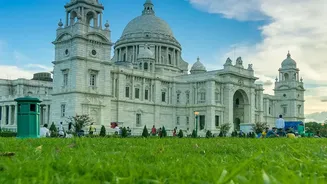
Perhaps no structure embodies the 'London of India' title more than the Victoria Memorial. Conceived by Viceroy Lord Curzon after Queen Victoria's death, this magnificent white-marble monument was built between 1906 and 1921. Designed by British architect Sir William Emerson, its style is primarily Indo-Saracenic, which fuses British, Mughal, and other Indian design elements. Made from the same Makrana marble as the Taj Mahal, its grand central dome, sprawling gardens, and regal presence make it the city's most iconic landmark and a powerful symbol of the colonial era's architectural ambitions.
A Tale of Two Rivers
The comparison extends beyond architecture to geography. Just as London thrived on the banks of the River Thames, Kolkata’s growth is intrinsically linked to the Hooghly River. The Hooghly, a major distributary of the Ganges, was the city's lifeline, transforming it into a bustling port and a critical hub for trade and commerce for the East India Company. The riverbanks, with their ghats, promenades, and old warehouses, create a visual and functional parallel to London's own riverside landscape, reinforcing the connection between the two imperial cities.
A Hub of Culture and Intellect
Beyond the physical resemblance, Kolkata was also the intellectual capital of India during this period. Much like London, it became a nucleus for education, law, arts, and science. The establishment of universities, publishing houses, and exclusive social clubs, often modelled on their London counterparts, fostered a unique 'Babu culture'—a blend of English liberalism and Bengali intellectualism. This environment gave rise to the Bengal Renaissance, a period of profound social and cultural reform, drawing another parallel to London's status as a global centre for thought and culture.