





The Pluto We Thought We Knew
For decades, our image of Pluto was that of a distant, static ice ball. Limited by the power of Earth-based telescopes, scientists presumed it was a geologically dead world, its surface frozen and unchanging for billions of years. That all changed in July
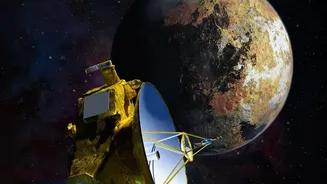
2015, when NASA's New Horizons spacecraft flew past the dwarf planet, sending back the first-ever close-up images of its surface. The probe revealed a world of stunning complexity, with vast nitrogen glaciers, towering mountains of water ice, and a thin but present atmosphere. The most striking feature was Tombaugh Regio, a bright, heart-shaped plain. The western lobe of this feature, a smooth, crater-free expanse named Sputnik Planitia, immediately hinted that our old assumptions were wrong. A lack of impact craters means a surface is young, suggesting it has been resurfaced by geological processes.
A Surprise in the Nitrogen Ice
Recent analysis of those same New Horizons images has provided even more startling evidence. A study published in the Planetary Science Journal provides the first evidence of recently flowing liquid on Pluto. Researchers focusing on the northern edge of Sputnik Planitia identified dark features that strongly resemble areas on Earth's glaciers that have been wetted by liquid. Since Pluto's frigid atmosphere makes nitrogen rain impossible, the team concluded that liquid nitrogen is likely welling up from beneath the surface through cracks in the ice. This process, known as cryovolcanism, is like Earth's volcanism but with molten ice and volatiles instead of molten rock. The patterns suggest this isn't just an ancient phenomenon but one that may be happening from time to time in the present day.
Rewriting the Geological Clock
This discovery of potential ongoing activity fundamentally alters Pluto's geological timeline. Previous models of cryovolcanism on Pluto suggested eruptions might have occurred within the last billion years—already a surprisingly recent timeframe. However, the evidence of liquid nitrogen seeping onto the surface suggests a much more current process. Some models even propose that major flow events could have happened within the last few hundred years, a mere blink of an eye in cosmic terms. Further evidence of a dynamic world comes from the discovery of massive landslides along the inner walls of craters, large enough to bury entire cities on Earth. These landslides, along with the vast, uncratered plains of Sputnik Planitia, point to a world that is actively reshaping itself, not one that has been frozen in time for eons.
The Engine of a Dwarf Planet
The big question this raises is: what is powering this activity? For a small, distant world like Pluto, retaining enough internal heat to power geological processes over 4.5 billion years is a major puzzle. One leading hypothesis is the existence of a liquid water ocean beneath its thick crust of water ice. While the surface is far too cold for liquid water, the internal heat from Pluto's formation, combined with insulating layers, could have kept a subsurface ocean from freezing. This internal heat could be enough to melt reservoirs of more volatile ices like nitrogen, which have much lower melting points, and drive them to the surface. Scientists are exploring various scenarios, from heat retained since Pluto’s violent formation to the insulating effects of certain materials in its crust, to explain how this tiny world stays so surprisingly active.