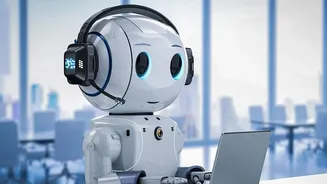








The conversation around AI is shifting from handy assistants to autonomous agents that can manage entire workflows. This evolution isn't just a tech upgrade; it's a fundamental change that could soon redefine technology service jobs.
From Assistant to Autonomous Agent
For years, AI has
been an 'assistant' or 'copilot', helping humans perform tasks faster. Think of chatbots that suggest answers or code helpers that complete lines for developers. An AI agent is different. It's a system that can perceive its environment, reason, make a plan, and execute multi-step tasks to achieve a goal with minimal human supervision. Instead of just telling you how to reset a password, an agent can read the support ticket, verify the user's identity, perform the reset, update the ticket, and close it on its own. This leap from task support to workflow ownership is why businesses are paying close attention.
Why is Demand Surging Now?
The market for AI agents is forecast to grow at a staggering rate, with some estimates projecting a CAGR of over 49% between 2026 and 2033. This boom is driven by a convergence of factors. Advances in large language models (LLMs) have given agents the power to understand complex instructions and make contextual decisions. Simultaneously, businesses are under immense pressure to improve efficiency, reduce operational errors, and handle massive volumes of data in real time. AI agents promise to deliver on these needs by automating repetitive processes, freeing up human workers for more creative and strategic work. Major cloud providers like Microsoft, Google, and Amazon are all reporting accelerating growth in their AI and cloud services, signalling strong enterprise demand.
The Front-Line Jobs Being Reshaped
The impact of AI agents will be felt most acutely in roles filled with routine, predictable tasks. Technology services are at the epicentre of this shift. Level-1 IT support and helpdesk jobs, which often involve handling repetitive issues like password resets and basic troubleshooting, are highly susceptible to automation. An AI agent doesn't need to resolve 100% of tickets to change the staffing equation; if it handles even 30-50% of the volume, fewer technicians are needed for that tier of work. Other roles being reshaped include manual software testing, routine coding, and back-office BPO functions. Customer service is another key area, with some analysts predicting AI could cause a significant reduction in current jobs by 2030 as agents handle common inquiries.
India's IT Sector at a Crossroads
For India's massive IT and business process outsourcing (BPO) industry, this is a pivotal moment. The sector has long been built on a foundation of skilled human capital executing tasks for global clients. AI automation is expected to change roles across software development, testing, and support within the Indian IT industry. While this might sound alarming, it's more of an evolution than an elimination. The consensus is that AI won't end IT jobs in India, but redefine them. Demand for roles that involve routine coding and support will likely shrink, while demand for professionals who can design complex systems, integrate AI tools, ensure cybersecurity, and manage data will rise.
The Future is Augmentation, Not Just Automation
The most likely future isn't a battle of 'man vs. machine', but a collaboration of 'man with machine'. As AI agents take over high-volume, process-driven work, it frees up human employees to focus on higher-value contributions like strategic thinking, complex problem solving, and building client relationships. In this model, the human worker's role shifts from doing the task to supervising a team of AI agents, ensuring quality, and handling the complex exceptions that the AI cannot. This makes human judgment, empathy, and creativity more valuable than ever. However, this also means the bar for entry level roles is rising; new hires will be expected to do more than just follow a script.
The New In Demand Skill Set
Thriving in an AI augmented workforce requires a new set of skills. 'AI fluency', or the ability to communicate effectively with AI systems through prompt engineering, is becoming a core competency. Professionals will also need strong critical oversight skills to review, verify, and debug AI generated work. As AI handles lower level execution, the demand for high level abstract thinking and system design grows. Beyond technical skills, soft skills like communication, collaboration, and adaptability are becoming even more critical to manage human AI teams and translate AI outputs for business stakeholders. The future belongs to adaptable professionals who focus on continuous learning and work with AI rather than trying to compete against it.