








The Last-Mile Problem
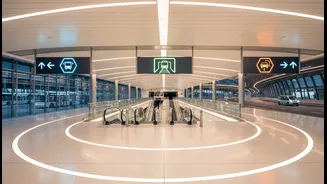
In infrastructure planning, it’s called the “last-mile” problem, and it’s the crucial difference between a world-class travel experience and a frustrating bottleneck. An airport, no matter how advanced, is only as good as its connections to the city it serves.
If the journey to or from the terminal is plagued by traffic jams, inadequate public transport, and unpredictable travel times, the time saved in the air is quickly lost on the ground. This isn't just an inconvenience; it’s a massive economic drag. Poor last-mile connectivity can deter business travel, complicate logistics, and limit a region's economic potential. A 2021 study, for instance, found that 70% of potential metro users in Bengaluru avoided the system partly due to poor access to stations, highlighting how a disconnect between major infrastructure and local transport can undermine its value.
Learning from Bengaluru's Experience
Bengaluru’s Kempegowda International Airport (KIA) is a classic case study. Opened in 2008, it is located about 35 kilometres from the city centre. For years, travellers have wrestled with a long and often gridlocked journey by road. While a beautiful airport, the difficulty in reaching it became a defining feature of the travel experience. The initial plan for a high-speed rail link was scrapped due to high costs. Now, years later, a metro line to the airport is under construction, with a targeted completion date around the end of 2026 or early 2027. This long-awaited link underscores a critical lesson: ground transport infrastructure cannot be an afterthought. It must be planned and executed in parallel with the airport itself.
India's Newest Airports: A Connectivity Race
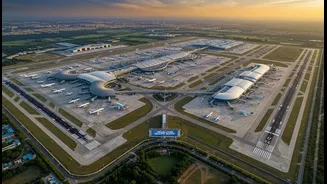
Planners seem to have taken these lessons to heart with India's next generation of mega-airports. The new Noida International Airport (NIA) at Jewar and Navi Mumbai International Airport (NMIA) are being developed with multi-modal connectivity as a core principle. For Noida Airport, which began operations in mid-2026, the Yamuna Expressway provides the primary road link for now. However, a far more ambitious network is taking shape, including a proposed link to the Namo Bharat RRTS and the Delhi-Varanasi bullet train corridor. These projects aim to create high-speed links to the wider National Capital Region and beyond, transforming the airport into a true multi-modal hub. Similarly, Navi Mumbai International Airport, which saw its first flights in late 2025, is being connected via the Mumbai Trans Harbour Sea Link, coastal roads, and multiple metro lines. The approved Metro Line 8, the 'Gold Line', is even planned to directly connect Navi Mumbai's airport with the existing one in Mumbai, creating one of India's first airport-to-airport metro corridors.
More Than Just Roads: The Multi-Modal Mandate
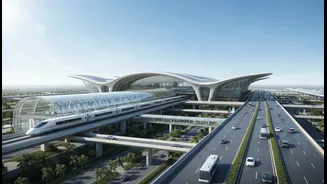
The most effective airport transport ecosystems offer a variety of choices. Relying solely on highways is a recipe for congestion. A multi-modal approach, integrating road, bus, metro, and rail, provides resilience and choice for travellers. Delhi’s Airport Express Metro Line is an example of this. After a rocky start with low ridership and operational issues, it has since become a vital artery connecting the airport to the city centre. Its revival, following fare reductions and operational adjustments by the DMRC, proves that a well-run, affordable mass transit option is highly attractive to passengers. For India’s new airports, providing seamless interchanges between these different modes will be the key to avoiding the transport chaos that plagues so many other global cities.
The Rise of the Aerotropolis
This integrated approach is part of a larger concept known as the "Aerotropolis"—a city planned around its airport. Coined by urban economist John Kasarda, the model treats the airport not just as a transport facility but as the central economic driver of a region, with clusters of aviation-linked businesses, logistics hubs, commercial centres, and residential areas built around it. India is actively pursuing this model, with plans for an aerotropolis around Noida International Airport. The goal is to create a self-sustaining ecosystem where the airport and its surrounding developments are synergistically linked by efficient transport. When done right, an aerotropolis can attract investment, create jobs, and make a region more globally competitive.