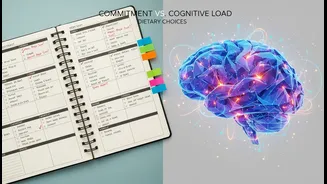









The Daily Grind of Decision Fatigue
For decades, the dominant approach to weight management has been centered on calorie restriction, a method that demands constant vigilance. This involves tracking every morsel of food, calculating calories, and balancing macronutrients. While effective
for some, it creates a significant mental load. The average person makes dozens, if not hundreds, of food-related decisions daily, leading to what psychologists call “decision fatigue”. This mental exhaustion depletes willpower, making it harder to resist impulsive, less healthy choices, especially at the end of a long day. This constant cognitive effort is a major reason why many people find traditional diets difficult to maintain long-term; the mental burden simply becomes too heavy.
Intermittent Fasting's Simple Rule
Intermittent fasting shifts the focus from what you eat to when you eat. This fundamentally changes the decision-making process. Instead of countless small decisions about food content and quantity throughout the day, the primary rule is a simple binary: Am I in my eating window, or am I in my fasting window? This simplification dramatically reduces the daily mental load. For many, this makes the entire process feel more manageable. Plans like the popular 16:8 method (fasting for 16 hours and eating within an 8-hour window) remove the guesswork and constant negotiation that often accompany traditional diets.
Why Adherence is the Real Goal
The secret to any successful health plan isn't the plan itself, but one's ability to adhere to it over time. Research suggests that non-adherence is often a behavioral problem, not a knowledge problem; people know what to do but struggle to do it consistently. Studies comparing intermittent fasting to continuous calorie restriction have found similar weight loss results, but some have noted higher adherence rates for fasting protocols. Participants in some fasting studies report that it feels easier to maintain because it doesn't require constant monitoring of food intake. By lowering the mental barrier to entry and execution, IF provides a sustainable alternative for those who find calorie counting unsustainable.
It's Not a Magic Bullet
Of course, intermittent fasting is not without its challenges. The initial adjustment period can be difficult, and the restrictive eating windows can interfere with social events or family meals. It's also not suitable for everyone, particularly individuals with certain health conditions. However, the key takeaway is the principle it demonstrates: many people are willing to trade a period of acute difficulty (adjusting to fasting) for the long-term benefit of reduced daily cognitive strain. The quality of food consumed during the eating window also remains critically important; filling it with nutrient-dense foods like lean proteins, healthy fats, and whole grains is essential for success.
A Lesson for the Future of Wellness
The success of intermittent fasting signals a broader shift in how we should approach health and wellness. It underscores a growing demand for systems that are psychologically smart, not just technologically advanced. The future of effective health interventions likely lies in what experts call "behavioral design"—creating plans and tools that work with our natural cognitive limits, not against them. This involves designing for adherence by reducing friction and simplifying choices. Whether it's through personalized AI-driven health plans, apps with clever reminders, or dietary frameworks that minimize decision-making, the lesson from IF is clear: the best plan is the one that you can actually follow, and making it easier to follow is the most crucial design feature of all.