



The Simple 'Twinkle Test'
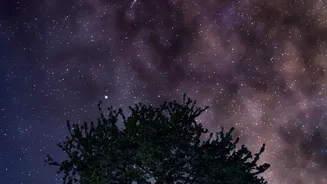
The easiest and most famous method to tell a planet from a star is to see if it twinkles. Stars, being incredibly far away, appear as single pinpoints of light. As their light travels through the Earth’s turbulent atmosphere, it gets bent and distorted,
causing the flickering effect we call twinkling. Planets in our solar system are much closer. Though they look like points to our naked eyes, they are actually tiny disks. The light from this larger surface area is less affected by atmospheric disturbances; the refractions tend to average out, resulting in a steadier, more constant glow. So, if you spot a bright 'star' that isn't twinkling, there's a good chance you are looking at a planet.
What to Look For This October
This October is a fantastic month for planet spotting. Saturn will be a prime target, reaching opposition on October 4. This means it will be opposite the Sun in our sky, making it visible all night long and at its brightest for the year. It will appear as a bright, steady, yellowish-white point of light. Jupiter, another brilliant object, will dominate the pre-dawn sky, rising in the middle of the night. Mars will also be visible after midnight, appearing as a reddish point of light. Venus, however, will be very difficult to spot for most, as it remains very low on the horizon just after sunset.
Follow the Celestial Highway
Planets don't just appear anywhere in the sky. They travel along a relatively narrow path called the ecliptic. This is the plane of Earth's orbit around the Sun, and from our perspective, it's the path the Sun appears to take through the sky over the course of a year. Because all the planets in our solar system orbit on roughly the same plane, you will always find them on or near this celestial highway. The Moon also follows this path. So, if you find the Moon, you know you are looking in the right zone for planets. If a bright, steady light is far from this path, it's almost certainly a star.
Watch for the 'Wanderers'
The word 'planet' comes from the ancient Greek word for 'wanderer'. This is the final and most definitive clue. While it takes more than one night of observation, planets move against the backdrop of fixed stars. If you note the position of a bright object relative to the surrounding stars and then check again a few nights or a week later, you'll see a planet has shifted its position slightly. Stars, on the other hand, maintain their patterns for thousands of years. This slow, majestic dance is what truly sets the planets apart and makes tracking them a rewarding hobby. For example, in October 2026, Jupiter will be seen growing closer to Mars throughout the month.
Useful Tools for Beginners
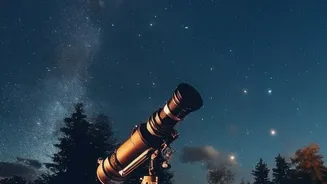
You don't need a telescope to start, but your smartphone can be an invaluable tool. Apps like SkyView, Star Walk 2, or Stellarium Mobile can help you identify what you're looking at in real-time. You just point your phone at the sky, and the app will use augmented reality to label the stars, constellations, and planets. Some apps popular in India, like Bhagol (formerly Indian Sky Map), offer a localised experience. These tools are perfect for confirming your suspicions. Once you've identified a planet using the twinkle test or its location, an app can confirm it for you and provide a wealth of extra information. A good pair of binoculars can also enhance your viewing, revealing the colours of planets more clearly or even the larger moons of Jupiter.