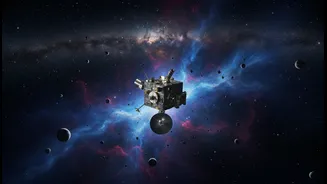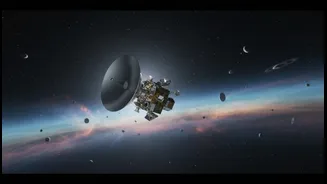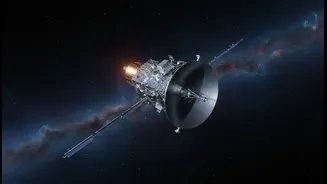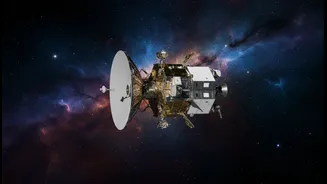




An Epic Journey So Far
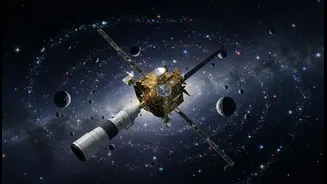
Launched in 2006, New Horizons is one of humanity’s most ambitious explorers. Its primary mission was the first-ever flyby of Pluto, which it successfully completed in 2015, transforming our view of the dwarf planet from a fuzzy dot into a complex world
with mountains of water ice and vast nitrogen glaciers. But its journey didn't stop there. In 2019, the spacecraft reached an even more distant object, a strange, snowman-shaped body called Arrokoth, located in the Kuiper Belt. This made Arrokoth the most distant object ever explored up close, offering a glimpse of a world left largely untouched since the solar system began.
Waking Up in the Kuiper Belt
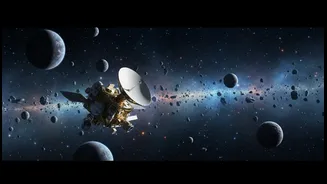
On July 7, 2026, NASA announced that New Horizons had successfully emerged from its longest-ever hibernation period. These long naps are standard procedure for the mission, designed to conserve power and reduce wear and tear on the spacecraft’s systems during the long, quiet cruise between points of interest. While most systems were powered down, key instruments continued to gather data on the surrounding environment. Now fully awake, the spacecraft is beaming this treasure trove of information back to Earth. Due to the immense distance, the signals, traveling at the speed of light, take nearly nine hours to reach mission control.
A Frozen Time Capsule
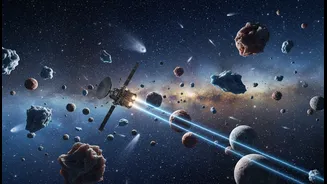
The Kuiper Belt, a vast donut-shaped ring of icy bodies beyond Neptune, is the primary reason this extended mission is so scientifically valuable. This region is essentially a frozen time capsule. The objects within it are considered primordial matter—leftovers from the formation of the solar system about 4.6 billion years ago. The solar system formed from a giant, spinning cloud of gas and dust known as the solar nebula. While most of this material clumped together to form the sun and planets, the icy bodies of the Kuiper Belt were left behind, preserved in a deep freeze. Because they have remained so cold and undisturbed, they offer a direct look at the original building blocks of planets.
What We Hope to Learn
By studying the Kuiper Belt, New Horizons is addressing fundamental questions about our origins. Its instruments are analyzing the dust and plasma environment, providing a unique dataset from a region no other active spacecraft is exploring. Scientists are using New Horizons to measure the solar wind—the stream of particles flowing from the sun—at the far reaches of its influence. This helps map the boundary between our solar system and interstellar space, a mysterious region known as the heliosphere. Furthermore, by observing the faint light from distant Kuiper Belt Objects, the spacecraft provides clues about their size, shape, and composition, helping scientists piece together the story of how planetesimals—the seeds of planets—first formed.
The Mission Continues
New Horizons is now serving as a unique deep-space observatory. In the coming weeks, it will begin new observations, including studying the distribution of hydrogen gas at the edge of the solar system. While its flyby days might be over unless a new target is found, its role in gathering data from the cold, dark frontier is far from finished. The spacecraft is healthy and could continue operating well into the 2040s, pushing ever deeper into the void and potentially becoming just the third human-made object to cross into interstellar space. Each packet of data it sends back helps us understand not only the distant worlds it passes but also the genesis of our own planet.