






A Telescope on Two Continents
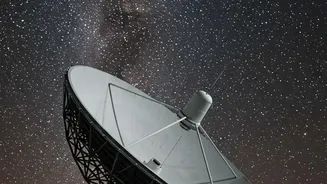
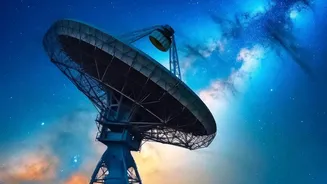
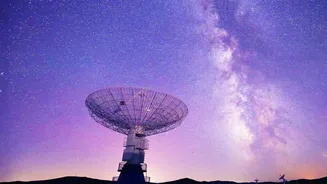
The Square Kilometre Array (SKA) isn't a single instrument in one location. It is a next-generation radio observatory with two distinct telescope arrays being built in the remote, radio-quiet deserts of South Africa and Australia. The South African site,
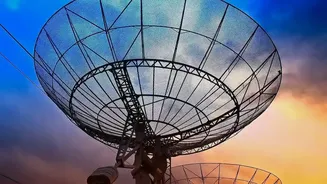
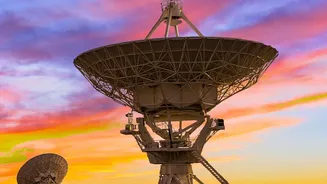
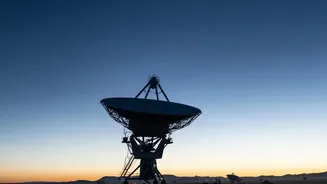
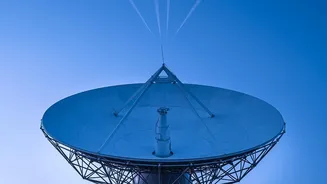
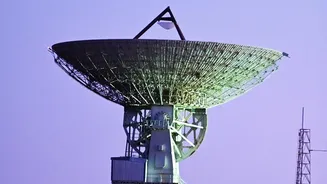
SKA-Mid, will feature 197 large dish antennas, which will eventually include the existing MeerKAT telescope. Meanwhile, the Australian site, SKA-Low, will be a sprawling forest of over 131,000 smaller, Christmas-tree-like antennas. These two complementary sites, coordinated from the observatory's global headquarters in the United Kingdom, will work together as a single, colossal telescope, giving astronomers an unparalleled view of the cosmos across different radio frequencies.
India's Role: The Brain of the Operation
India is not just a participant in this ambitious project; it is a full member and a crucial contributor. The nation's involvement is coordinated by the Pune-based National Centre for Radio Astrophysics (NCRA), which draws on its decades of experience operating the Giant Metrewave Radio Telescope (GMRT), itself an SKA Pathfinder facility. India's most significant contribution is leading the international consortium that designed and is now developing the Telescope Manager. Often described as the 'neural network' or 'brain' of the entire observatory, this complex software system will be responsible for controlling and monitoring the telescopes, issuing commands, and ensuring astronomical observations run smoothly. With a commitment of ₹1250 crore, India is also contributing to key digital hardware and will host a regional data centre to process the vast amounts of information the telescopes will generate.
Peering into the Cosmic Dawn
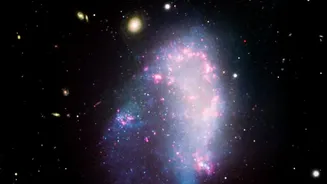
The SKA's primary mission is to answer some of the most fundamental questions in astrophysics. Its unprecedented sensitivity will allow scientists to look back over 13 billion years to a period known as the 'Cosmic Dawn'. This is the era when the very first stars and galaxies began to form, igniting the universe out of a period of darkness. By detecting the faint radio signals emitted by neutral hydrogen from this epoch, the SKA will map the structure of the early universe in three dimensions, revealing how the cosmos as we know it today came into being. This leap in capability is like moving from a black-and-white photograph to a high-definition, 3D movie of the universe's infancy.
Unraveling the Universe's Deepest Mysteries
Beyond the early universe, the SKA's scientific goals are incredibly broad. It will probe the nature of dark energy, the mysterious force causing the universe to expand at an accelerating rate, and investigate the distribution of dark matter, the invisible substance that makes up most of the universe's mass. The observatory will also create detailed maps of cosmic magnetism, test Albert Einstein's theories of gravity in extreme environments—such as around pulsars and black holes—and even join the search for extraterrestrial life by scanning for potential biosignatures in the atmospheres of distant planets. The sheer volume of data it collects is expected to lead to discoveries that we cannot yet even imagine.
From Construction to Discovery
The journey to build this mega-telescope is a monumental undertaking in itself, with formal construction having commenced in late 2022. As of 2026, teams in Australia and South Africa are busy with infrastructure work, installing the first antennas and erecting the massive dishes. The project is being rolled out in phases, with scientific capabilities gradually increasing. The first chance for the global astronomy community to access SKA data will come during a 'Science Verification' phase. Early science operations are expected to begin around 2028 or 2029, with the telescopes reaching full operational capacity by the end of the decade, heralding a new golden age of astronomical discovery.